
CapitalCore: broker review, trader feedback, and whether it’s worth trusting
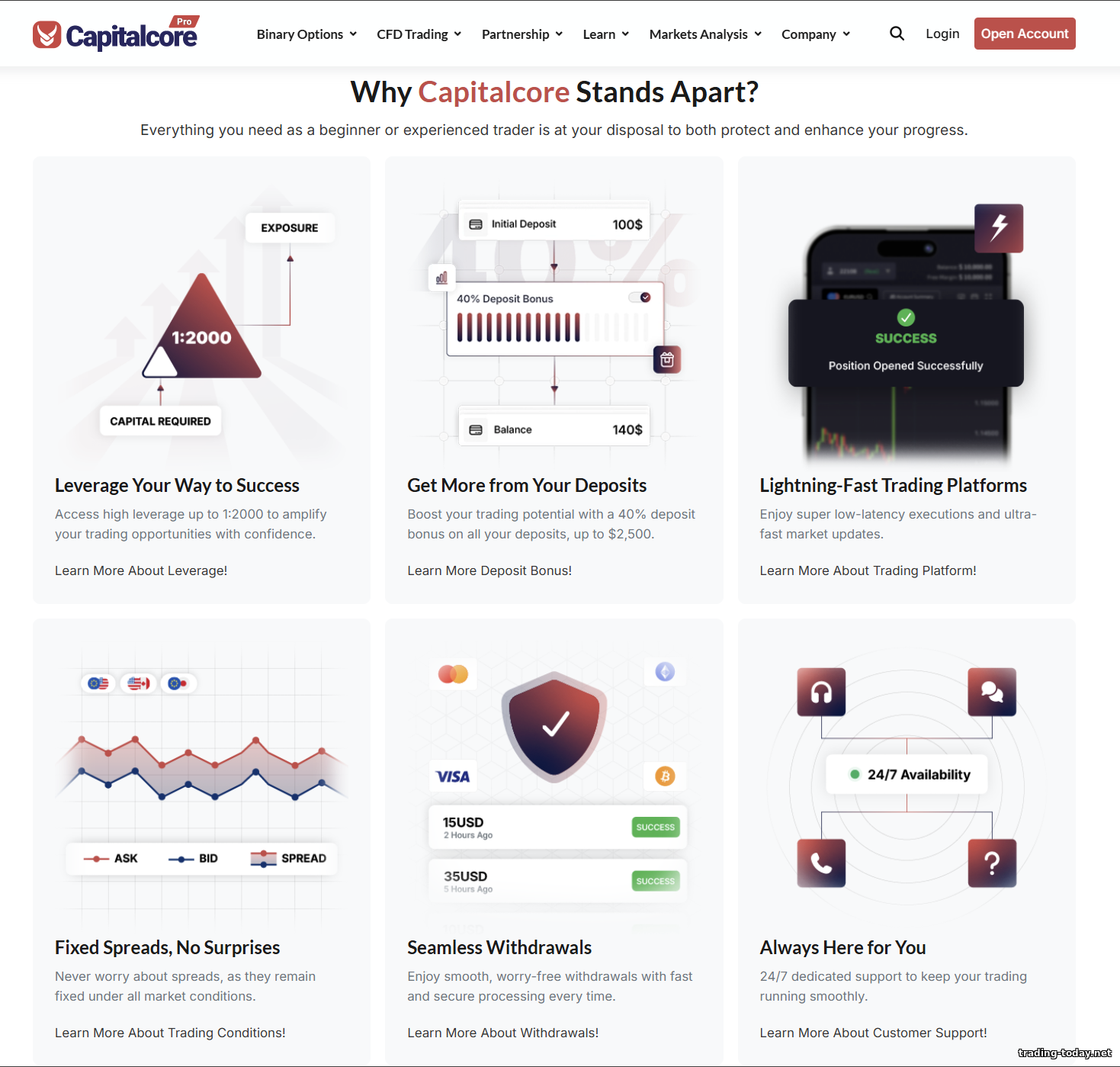
Leverage of 1:2000, binary options with payouts up to 95%, and a minimum deposit of just $10 can sound appealing to almost any trader. CapitalCore attracts attention with exactly those conditions. It’s a relatively young forex broker and online trading platform that brings together the classic Forex/CFD market and High/Low binary contracts under one account. The company started operating in 2019 and is registered offshore in Saint Vincent and the Grenadines. CapitalCore offers trading in currencies, metals, indices, stocks, and cryptocurrencies, and also lets you place higher/lower bets via fixed-time options on those same assets. The broker uses a proprietary platform (built around TradingView) with robust charts, provides 24/7 client support, and advertises a +40% bonus when funding the account. On paper, CapitalCore checks many boxes that can interest traders: ultra-high 1:2000 leverage, swap-free conditions for holding positions overnight, a very low entry threshold, and even access for clients in countries where some competitors do not operate (for example, the U.S.).
But how reliable is CapitalCore in practice? An offshore registration without recognized top-tier licenses raises questions about broker oversight and fund safety. The trading industry has seen cases of abuse by offshore firms, so experienced traders typically stay cautious. In this review, we’ll break down what sets CapitalCore apart from competitors (Quotex, Binomo, Binolla, Deriv), what its trading conditions look like, what real client feedback says, and most importantly—whether this online broker is worth trusting. The goal is an objective, highly informative (and not boring) overview so you can decide for yourself if it’s worth the risk.
Contents
- Regulation and CapitalCore reliability
- Account types and trading conditions
- CapitalCore trading instruments
- Trading platforms and technology
- Deposits and withdrawals
- Trading fees and spreads
- Customer support and trader education
- Affiliate program and extra features
- Pros and cons of CapitalCore
- CapitalCore vs other brokers
- CapitalCore FAQ
- Conclusion
Regulation and CapitalCore reliability
Under what jurisdiction does CapitalCore operate? The broker says it is registered in Saint Vincent and the Grenadines and operates based on authorization from the local IFSA (International Financial Services Authority). However, an important detail matters here: the government of Saint Vincent does not officially regulate forex brokers or binary options platforms. IFSA is not a full-fledged financial regulator, but more of a registration body. In major public databases (for example, IOSCO), this regulator is not listed. On top of that, it’s not possible to verify whether CapitalCore has a genuine, specific license—IFSA license numbers are not published by the company. In practice, this means CapitalCore operates without oversight from widely recognized regulators (such as the UK’s FCA or Cyprus’s CySEC).
Does CapitalCore have a license, and what is IFSA? Essentially, the broker does not hold a broadly recognized license. IFSA Saint Vincent is not the same as licenses from ASIC, FCA, FINRA, and similar authorities. This is an offshore registration that typically does not impose strict capital requirements or detailed reporting standards. Moreover, the IFSA website looks unprofessional (even the logo may not display), and there is no public registry where you could verify CapitalCore’s licensing status. In other words, IFSA is not a top-tier regulator, and referencing it offers limited assurance for clients.
What risks come with CapitalCore’s offshore status? First of all, no respected oversight means no clear investor protection. While regulated brokers in the EU, the UK, and Australia may be required to participate in compensation schemes (for example, FSCS insures up to £85k, and Cyprus’s ICF up to €20k), offshore companies typically provide nothing comparable. Your funds are not insured against company insolvency. Offshore brokers can also operate under their own internal rules: in theory, this can mean payout delays, trading disputes, or unilateral changes to terms. Without a regulator, there is nowhere to file a formal complaint in a dispute. The risk of unfair practices is generally higher than with regulated firms. That’s why clients should be extra careful: read the agreement, avoid keeping large balances on the account, and assess reputation across multiple sources.
Can you trust CapitalCore—does it look like a scam? There is no single definitive answer. No direct evidence of fraud by CapitalCore was found here, and the broker does process deposits and withdrawals. There are positive trader reviews online, and the company tries to maintain a reliability narrative (for example, on Trustpilot it maintains an “Excellent” rating around 4.4/5). Many clients praise fast withdrawals and a convenient platform: “they paid out in 30 minutes, the platform is great, and support is the best for us U.S. traders,” writes one user. Another notes: “fixed, low spreads, high leverage, 24/7 support, strong payouts—an ideal platform for me.” This kind of feedback suggests CapitalCore often delivers what it promises.
That said, it’s important to note the review base is still small—around 40 reviews on Trustpilot. Roughly 89% of users leave 5-star ratings, but there are also about 9% negative ratings. Some complaints involve the broker asking people to leave reviews even if they did not use the service (hinting at possible review boosting). In other sources, you can find stories about withdrawal difficulties or even account blocks without clear explanations—these reports are concerning, although it’s hard to verify authenticity. Overall, CapitalCore’s reputation remains mixed and not fully time-tested: the brand is young, operating since 2019, and it has not yet earned broad community trust.
CapitalCore rating distribution on Trustpilot: the vast majority of reviews are 5-star, while about 9% are 1-star. Total reviews are roughly 43, with a TrustScore around ~4.4/5.
How does CapitalCore claim to protect client funds? On its website, the broker mentions several measures: segregated client funds in separate accounts, transaction data encryption, and negative balance protection. In other words, client money is separated from company funds (at least on paper), and you should not be able to go below zero—losses are limited to your deposit. These are good practices that can improve confidence. But again, none of this is monitored by an independent top-tier regulator. Clients have to rely on internal company policies. In the event of a dispute or force majeure (employee fraud, hacking, insolvency), the trader will not have a third-party compensation fund or regulator to help recover funds. For that reason, we recommend approaching CapitalCore cautiously: do not invest money you cannot afford to lose, and withdraw profits regularly instead of keeping a large balance for long periods.
Account types and trading conditions
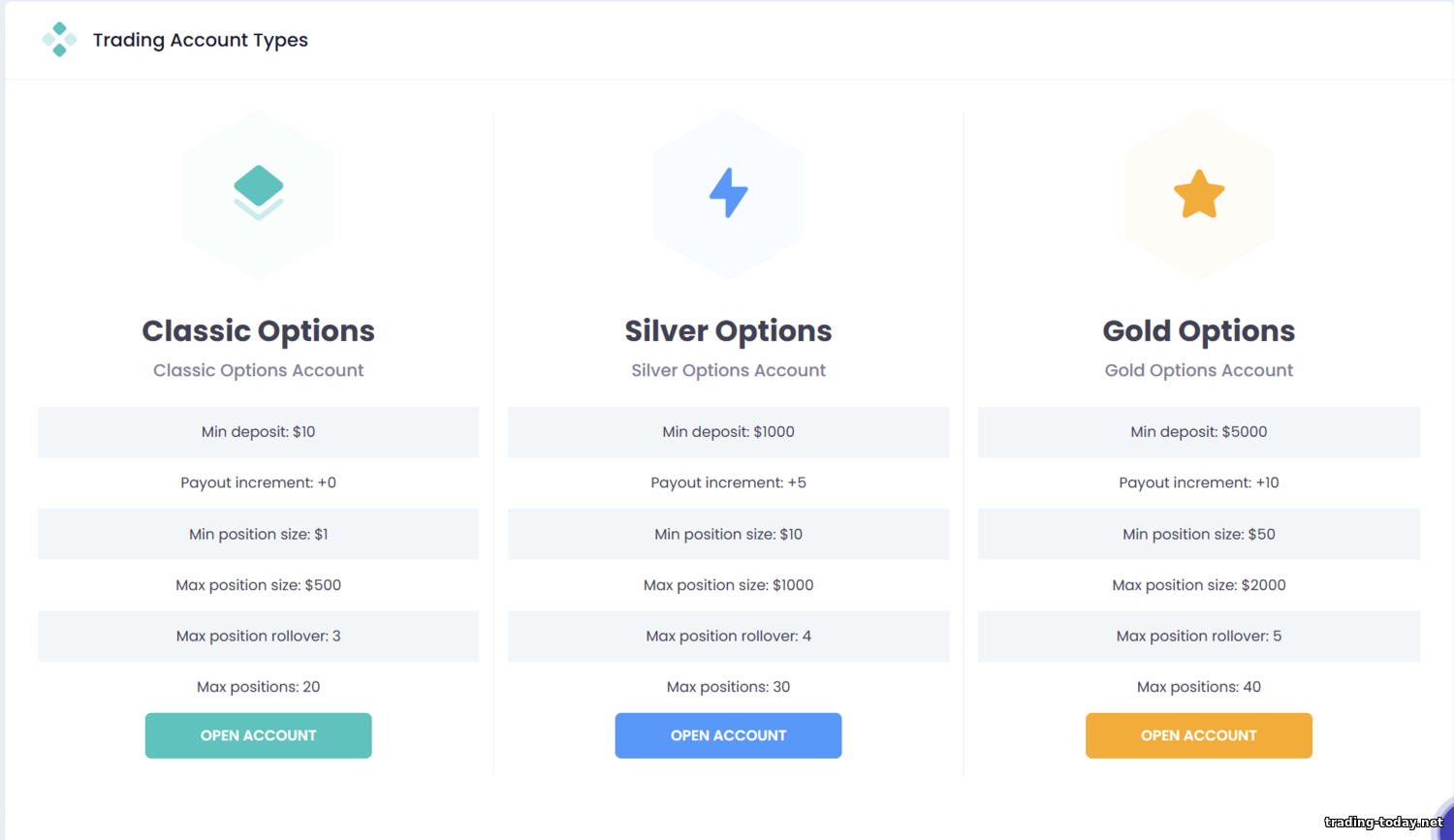
What trading account types does CapitalCore offer? The broker provides several account options with different conditions. For Forex/CFD trading, the available tiers are Classic, Silver, Gold, and VIP. Separately, for binary options trading, similar tiers are used (Classic, Silver, Gold)—they largely mirror the same levels. Below is a table summarizing the key parameters:
| CapitalCore account type | Minimum deposit | Trade size range (min–max) | Rollover (option extension) | Account highlights |
|---|---|---|---|---|
| Classic (standard) | $10 | from $1 to $500 | Up to 3 extensions | Entry-level account for beginners, full functionality, swap-free, leverage up to 1:2000 |
| Silver | $1 000 | from $10 to $1 000 | Up to 4 extensions | For more experienced traders: higher position limits, potentially tighter spreads, swap-free |
| Gold | $5 000 | from $50 to $2 000 | Up to 5 extensions | Premium tier: larger trades, maximum privileges, swap-free, possibly free VPS and better spreads |
| VIP | by invitation (roughly from $10 000) | Individually set | Individually set | Custom terms for high-volume clients: personal manager, lowest costs, priority withdrawals, free VPS, etc. |
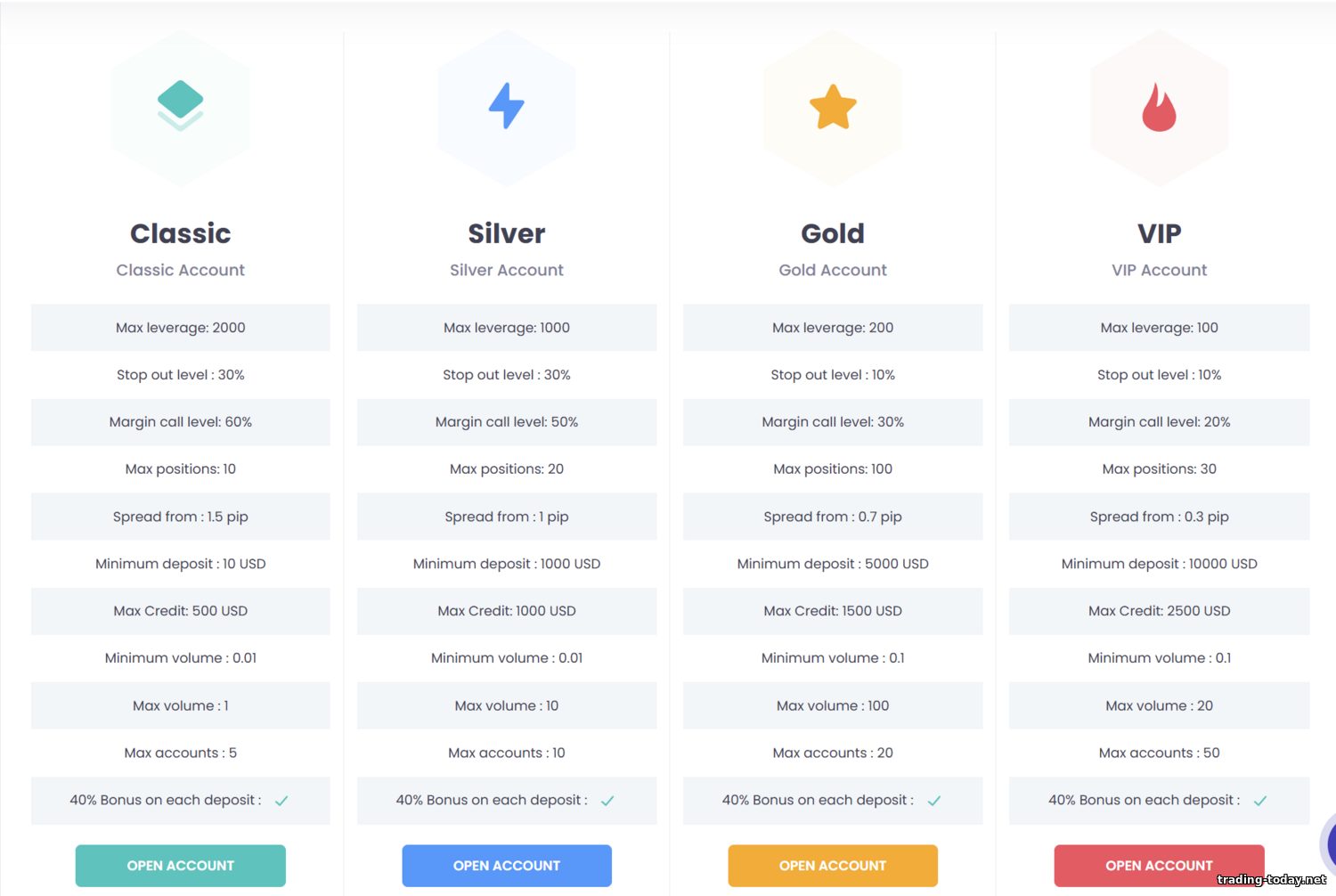
Note: Rollover is a feature that extends a binary option’s expiration time if you see your idea needs more time to play out. CapitalCore allows multiple extensions on higher tiers (for Classic—up to 3 times; for Gold—up to 5 times). This adds flexibility for short-term binary trading, although each extension usually reduces the potential payout.
As you can see, the entry threshold is very low: a Classic account can be opened with just $10, making it accessible to almost anyone. Even the minimum binary option stake is $1, so you can test strategies with very small amounts. This compares favorably with many competitors. For example, Binomo also starts at $10, while some forex brokers require $100 or more for ECN-type accounts.
Demo account. Before risking real money, anyone can open a free demo account with CapitalCore. The demo has no strict time or balance limits—you can practice as long as you need. The training account includes the same assets and platform features as the live account. This is a big advantage for beginners: you learn the interface, refine your approach, and only then move to real funds. Many brokers restrict demos to 30 days, but here that limitation is not emphasized. Opening a demo is simple: register on the site and switch between live and practice accounts with one click.
Leverage 1:2000—who is it useful for? CapitalCore allows CFD trading with leverage up to 1:2000, which is far higher than what regulated brokers typically offer (often 1:30–1:500). In practice, that means with $100 in your account you could open a position size up to $200,000. Such extreme leverage may appeal to experienced short-term speculators or traders with very small capital. For example, for aggressive growth of a small deposit, 1:2000 can theoretically amplify gains quickly. But it’s a double-edged sword: the same leverage also magnifies risk. A price move of just 0.05% against your position can wipe out a trade at 1:2000. For beginners, this tends to mean fast losses rather than profits. That’s why CapitalCore separately warns about margin-trading risks. In many cases, moderate leverage (up to 1:100) is more than enough for comfortable Forex trading. An extreme 1:2000 should only be used if you fully understand the consequences and follow strict risk management.
Are all CapitalCore accounts swap-free? Yes—one of the broker’s standout points is that no account type charges overnight swaps for holding positions. In effect, accounts work like Islamic (swap-free) accounts by default. You don’t pay interest for holding a position overnight, even if you keep it open for days or weeks. This can benefit mid-term and long-term traders because carrying costs are reduced. With traditional brokers, swaps are either charged (based on interest-rate differentials) or you can request a special swap-free account that may include commissions or wider spreads. CapitalCore removes swaps for everyone, emphasizing trader-friendly conditions and appealing to clients in Muslim-majority regions. It’s still worth remembering: if a broker does not charge swaps, costs can be embedded elsewhere—for example, slightly wider spreads on instruments where swaps would normally be significant. Even so, no overnight fee is a meaningful advantage for many traders.
Commissions and hidden charges. CapitalCore promotes a Zero Commission model—meaning there is no broker commission for entering or exiting trades. When trading FX pairs, you pay only the spread (the difference between bid and ask), with no fixed per-lot fee. For binary options trading, there is also no separate commission—you either receive a fixed payout or lose the stake. There is no inactivity fee, so you can pause trading without monthly penalties. The broker also states it does not charge account maintenance fees. Even deposits and withdrawals are usually processed with no broker fee or with minimal charges (we’ll cover this in the payments section). This can differentiate CapitalCore from competitors that may charge, for example, $10/month for account inactivity. The main exception is third-party payment fees. For instance, funding via Perfect Money can carry a 1% fee charged by the payment system itself, not by the broker.
Deposit bonuses. CapitalCore encourages traders with a +40% bonus on each deposit. That means if you fund your account with, say, $100, you get an additional $40 as bonus funds. The bonus is applied to every top-up, not just once. It can increase your available margin and allow larger positions or more trades. However, you typically cannot withdraw bonus funds immediately—first you must meet a trading turnover requirement. Many brokers require you to trade a volume multiple of the bonus amount (for example, 40–50x) before the bonus (or profits linked to it) can be withdrawn. If you try to withdraw before meeting the turnover, the bonus usually gets canceled. These promos can be useful, but only if you understand the conditions. CapitalCore notes on its site that bonuses must be “worked through” and advises reading the rules carefully so withdrawals are not delayed by unmet turnover. Overall, a 40% bonus is generous (many competitors offer 20–30% or none), but keep in mind: it’s not a gift—it’s more like a credit intended to increase trading activity. If you’re disciplined and plan to trade actively rather than withdraw right away, the bonus may help you scale faster. If you’re unsure about trading volume, it may be smarter not to take the bonus to avoid issues later.
CapitalCore trading instruments
What assets can you trade with CapitalCore? The broker provides access to major global markets. It claims 150+ tradable instruments, including Forex currency pairs, precious metals, stock indices, major company shares, commodities, and cryptocurrencies. On the CapitalCore platform, you can trade these markets in two ways:
- As CFD/Forex. This is classic leveraged trading: you open a buy or sell position and can close it at any time, taking profit or loss depending on price movement. Dozens of currency pairs are supported (from popular EUR/USD and GBP/USD to less common pairs), gold and silver (XAU/USD, XAG/USD), major indices (for example, S&P 500, Nasdaq, DAX), several commodity contracts (oil and gas—at least Brent and WTI are listed), and shares of selected companies (Apple, Tesla, etc.). Crypto CFDs are also mentioned—Bitcoin, Ethereum, and several altcoins. In other words, in CFD mode CapitalCore covers the main asset classes: FX, metals, indices, energy, stocks, and crypto. CFD trading is presented as commission-free, with costs coming from spreads, and with leverage up to 1:2000 on forex (some instruments may have lower leverage—for example, crypto often comes with smaller limits). As noted, all accounts are positioned as swap-free, so holding trades overnight does not add swap charges. Overall, CapitalCore tries to keep up with standard forex brokers in terms of core market coverage.
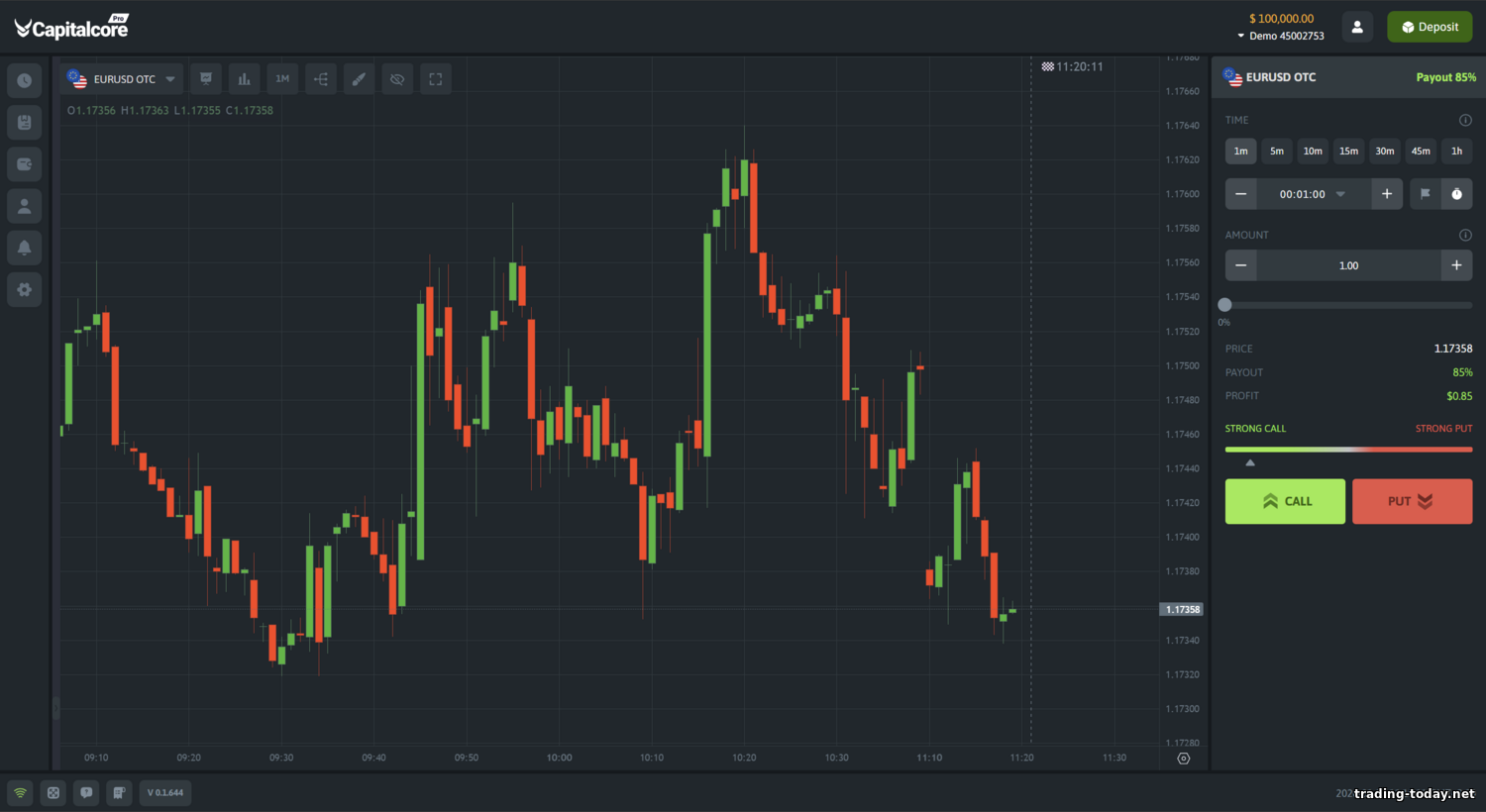
- As binary options. A key feature of CapitalCore is the ability to switch into a binary trading mode on the same platform. A binary option is a fixed-time bet on the direction of an asset’s price over a set period. The trader chooses an underlying market (currency, index, stock, crypto), sets an expiration (for example, 1, 5, 15, or 30 minutes), and predicts whether the price will be higher (Call) or lower (Put) than the current level at expiry. If the forecast is correct, the trader receives a fixed payout—typically 80–95% of the stake. If incorrect, the stake is lost. CapitalCore offers short expirations from 1 minute up to 1 hour. Options are available on key FX pairs, metals, most indices, and popular crypto markets (BTC, ETH). Payouts on the most liquid markets are strong—users note EUR/USD can reach up to ~90%, and gold can reach up to 95% on successful trades. Crypto payouts tend to be lower (during peak hours around ~84–87%). The number of available instruments in binary mode is a bit smaller than in CFD mode, but it still covers the main markets. It’s important to remember that fixed-time options are a very high-risk instrument. In practice, it’s a wager against the broker: when you win, the broker pays you; when you lose, your loss stays with the broker. Frequent trading without a system can quickly drain a deposit—especially when bonuses and high leverage tempt traders into oversized bets. Binary options are banned in the EU and Russia for a reason—many regulators view them as gambling-like products. Beginners should be especially careful: start with a demo, use the minimum stake, limit risk strictly, and avoid treating binaries like a lottery.
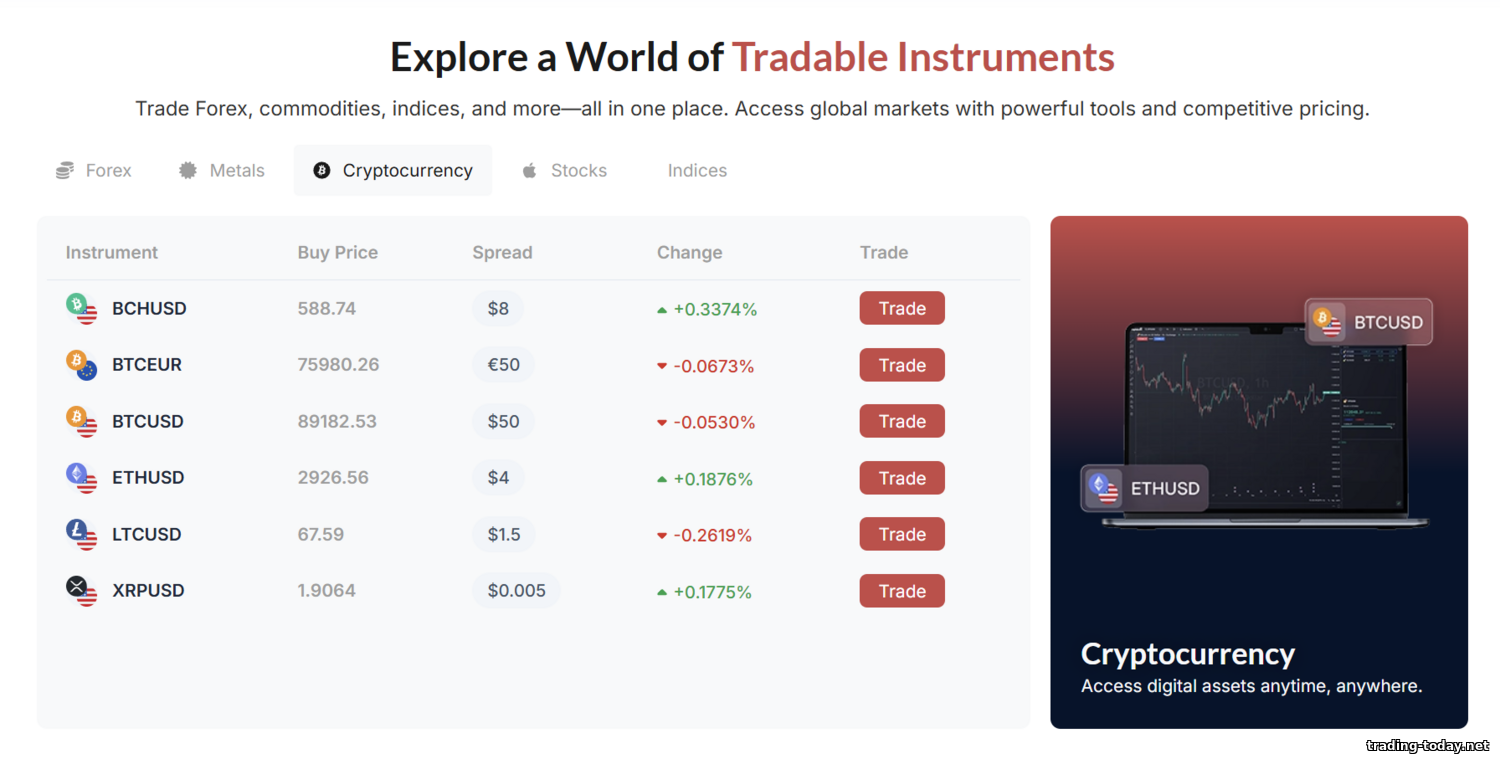
Are there any instrument limitations at CapitalCore? The selection is broad, but not perfect. Experienced traders will notice there is no trading in real ETFs or bonds, and there are no exotic commodities (for example, coffee and sugar are not listed). The stock list is limited to well-known U.S. names—you won’t find hundreds of shares like with large CFD brokers. Essentially, CapitalCore focuses on the most popular and volatile markets suitable for short-term speculation, which makes sense given the emphasis on binaries. If your strategy requires a very wide universe (for example, second-tier stocks or agricultural futures), this broker may not be ideal. There are also no range/ladder option types—only classic High/Low (higher/lower). The maximum expiration is 1 hour, meaning there are no daily or weekly binaries. On the other hand, the minimum expiry at CapitalCore is quite short—from 1 minute—while some competitors (like Quotex) even offer 30-second contracts. Overall, the toolset should be sufficient for about 90% of retail traders. The company also expands its list over time—for example, some cryptocurrencies were reportedly added this year that were not available before.
Spreads and payouts: what should traders expect? In Forex/CFD mode, spreads are described as floating, starting around 1.0–1.5 pips on major pairs. In practice, on Classic accounts EUR/USD is often around ~2 pips and GBP/USD around ~3 pips. On Gold/VIP tiers, spreads can be lower (closer to 1 pip), which is typical—larger deposits often come with better terms. Overall, CapitalCore’s spreads are around the market average: not record-tight like top ECN brokers, but not excessive either. For example, if EUR/USD is ~1.5 pips, the round-turn cost is roughly $15 per 1 lot—generally acceptable. Crypto spreads are wider: Bitcoin may show a $40–50 spread (also common across brokers due to BTC volatility). As for binary payouts, CapitalCore is positioned as one of the higher-payout platforms. On major pairs during active hours, you may see 85–90% payouts; on gold and some indices, up to 95%. For comparison, Binomo typically tops out around ~90%, and Pocket Option up to ~92%. A higher payout percentage can theoretically improve long-run expectancy (all else equal). Of course, the platform margin remains (100% minus the payout percentage). On popular instruments at CapitalCore, that margin is around 5–15%, which is competitive. On crypto binaries, payouts are lower—around 70–80%, i.e., a 20–30% margin—this is common because crypto markets are more volatile and risky.
An important point: order execution and price quotes. CapitalCore positions itself as an STP broker (for CFDs), meaning trades are routed to liquidity providers. It’s hard to verify independently, but execution quality can be inferred from user experience. Reviews and tests suggest that in calm market conditions, orders open and close quickly. During sharp price moves, slippage and even occasional requotes can occur. This is typical for many brokers without robust ECN infrastructure. Binary contracts are executed using TradingView quotes (provider: MarketData LLC); reviews generally do not report major issues with these quotes. If you trade ultra-short-term (scalping, news spikes), note that CapitalCore prohibits certain strategies: arbitrage, news robots, and scalper bots are not allowed. Manual scalping is not explicitly blocked, but during peak loads the platform can slow down slightly. For most traders, these nuances won’t be critical, but we mention them for completeness.
Trading platforms and technology
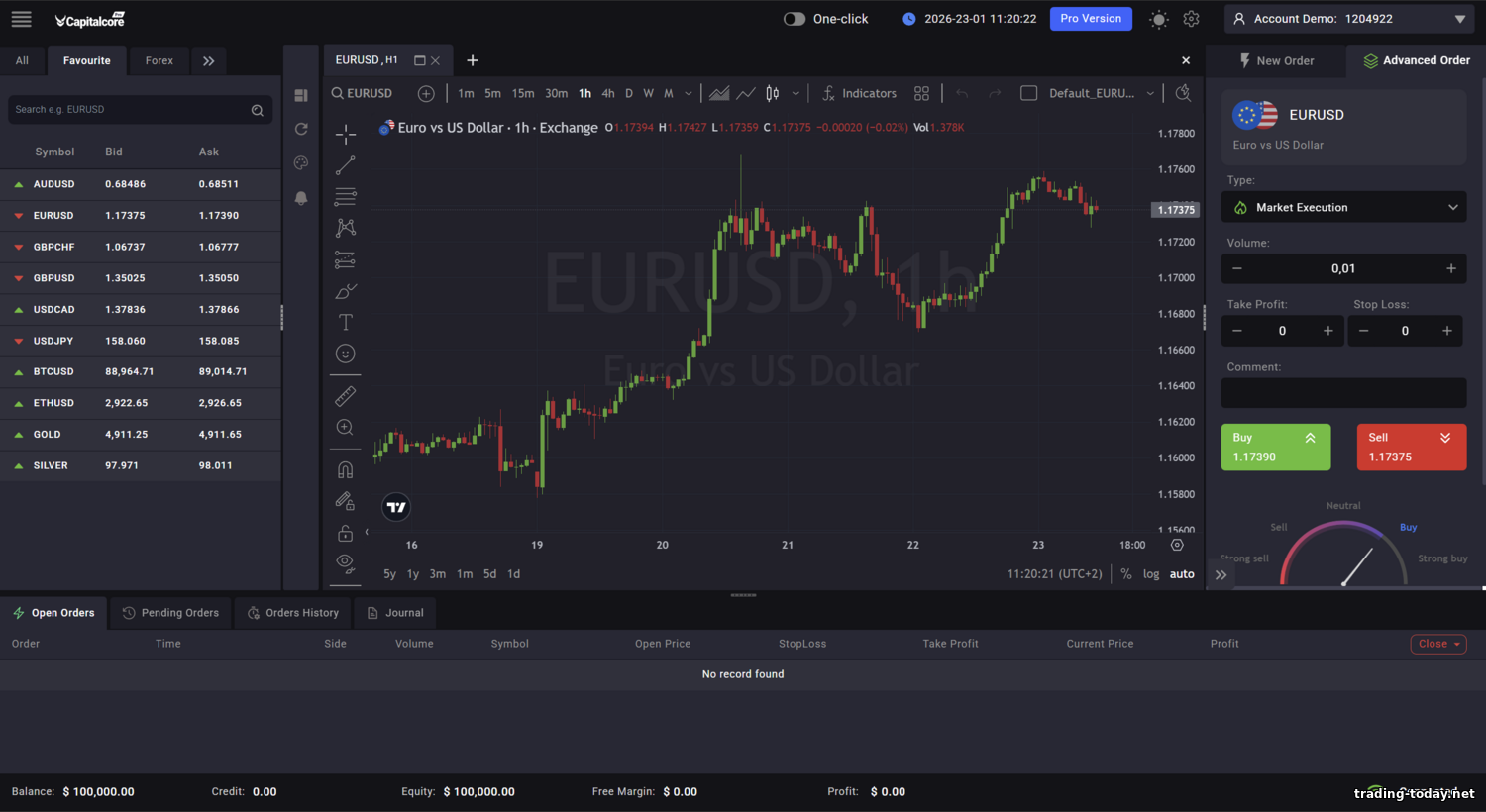
What platform do CapitalCore clients use? The broker offers its proprietary WebTrader platform, which runs in a browser and requires no installation. The main advantage is TradingView charts integrated inside the terminal. That means traders get familiar functionality: 100+ technical indicators, many drawing tools (lines, levels, shapes), and several chart types (candles, bars, area, etc.). The WebTrader interface is modern, includes a dark theme, and the panels are easy to navigate. On the left is the asset list with prices, in the center is a large chart, and on the right is the order panel (for CFDs) or Call/Put buttons (for binaries). You can open multiple tabs with charts for different instruments. The Forex order window includes all key fields: volume, stop loss, take profit, and order type (market or pending). For a binary contract, you choose the stake amount and expiration time, then place the trade with the relevant direction button.
CapitalCore WebTrader interface. In the center is a TradingView chart (example: EUR/USD, H1), and on the right is the trade entry panel. The platform combines Forex/CFD and binary options—mode switching is available at the top.
WebTrader stands out for its advanced charts and ease of use. For those used to TradingView, market analysis feels natural: popular indicators (moving averages, RSI, MACD, Stochastic, etc.) are available and can be customized. A social element from TradingView is also present—you can browse other traders’ ideas and forecasts (though this feature is more for exploration than for execution). Another advantage is the single account across all modes: you don’t need a separate binary options account—you simply switch modes in the top menu. The balance remains unified.
What is the CapitalCore “Pro” platform? In addition to the main WebTrader, the broker offers CapitalCore Pro—an alternative interface aimed at more advanced users. Essentially, Pro is a more customizable layout: you can move panels around, resize windows, and tailor the workspace. It’s described as having deeper TradingView integration, with additional timeframes and less common indicators. However, reviews suggest the Pro interface is less intuitive for beginners: there are fewer prompts, and it takes time to set up. Some call it a “lighter TradingView-style” layout—minimal menus, but requiring more familiarity. It’s likely intended for active traders who want maximum customization, while most newcomers will be perfectly fine with the standard WebTrader, which is already strong in functionality.
Does CapitalCore have a mobile app? Yes. For Android, a native app (CapitalCore app) is available via Google Play. For iOS, there may be no standalone app, but the site suggests using the web terminal on iPhone (as a progressive web app, PWA). The mobile platform is optimized for small screens: the interface is simplified, and buttons are large enough for quick actions. Core functions are available—opening/closing trades, chart indicators, deposits/withdrawals, and live chat support. According to feedback, the app is generally responsive, though occasional crashes are mentioned. On Google Play, the average rating is around ~3 out of 5, with some users pointing to minor bugs. Overall, mobile trading with CapitalCore is practical for monitoring positions and trading on the go, but full chart analysis is still more comfortable on desktop or tablet, where multiple indicators are easier to manage.
Does it support popular terminals like MetaTrader? No—CapitalCore does not support MetaTrader 4, MetaTrader 5, or cTrader. Trading is only available via proprietary platforms (web and mobile). This creates several limitations for advanced users:
- No trading robots (EAs). In MetaTrader, many traders run automated strategies or connect to signal copying. Here, that option is unavailable—there is no built-in auto-trading. The company also states that algorithmic news-scalpers and arbitrage bots are not allowed, and in practice there is nowhere to run them anyway.
- No importing custom indicators or scripts. MetaTrader is known for custom MQL indicators. CapitalCore is a closed system—you are limited to the standard TradingView toolkit available inside the platform.
- No integration with the familiar MT4/MT5 mobile apps. Many traders monitor trades via the official MetaTrader app—here you must use CapitalCore’s web interface or its own mobile application.
- No API integrations with external analytics services or bots, since CapitalCore does not provide an API (users often list this as a drawback).
For some traders, these constraints are significant. Many simply do not want to move away from MT4. Still, it’s worth noting that MetaTrader 4/5 can feel dated in terms of charting, while CapitalCore’s TradingView-based terminal is often stronger for manual trading. You get access directly in the browser, with no installation, and a more modern interface. So the MetaTrader question is largely about your workflow: if you are an algo trader or manager who relies on MT infrastructure, CapitalCore is not a fit. If you trade manually and value modern charting, the broker’s platform may suit you well.
What extra features does CapitalCore provide? The broker includes tools familiar from top binary trading platforms, such as Double Up and Rollover. Double Up lets you instantly double an open option position—effectively creating a second option with the same stake and expiration. This can be useful when you are confident and want to amplify exposure. Rollover, as discussed, extends the expiration time (up to 3 times on Classic and up to 5 times on Gold). Traders typically use rollover when price is moving in their favor but needs more time to finish the move—an extension increases the chance to end in profit. These features add flexibility to fixed-expiration trading. Not every broker offers both: for example, Quotex offers doubling, but not extension; Binomo often lacks both on standard accounts. In this sense, CapitalCore’s toolkit is competitive.
Other features include a One-Click mode (instant order placement by clicking a price without extra confirmation), an Advanced Order section (expanded order settings, such as a pending binary trade triggered at a specific price—an interesting and relatively rare function), plus an economic calendar and a news feed built into the platform. It’s also worth mentioning that CapitalCore offers a free VPS server for certain account tiers—typically higher ones such as Gold and VIP. A VPS can help maintain a stable connection 24/7. For example, if you hold longer-term trades, trade at night, or have unreliable internet, a VPS can reduce the chance of disconnecting at a critical moment. Even though MetaTrader robots are not supported here, a VPS may still be useful for stability. Access to VPS is usually provided on request via support and often depends on a minimum deposit (by analogy with other brokers, likely in the $1000–5000 range).
How reliable is the platform technically? Most feedback rates CapitalCore’s platform speed and stability positively. TradingView charts load quickly, and quotes generally do not freeze. Thanks to TradingView’s cloud infrastructure, the platform can handle volatility and sharp market moves reasonably well. Still, some tests have noted occasional issues: for example, the BrokerListings review mentions that during testing the web platform a couple of times failed to load fully or displayed a connection error. This can happen, especially with slow internet or blocked connections. A page refresh typically resolved the issue. Also, the mobile web version (PWA) can struggle on weak networks—some users prefer the Android app. Bottom line: CapitalCore’s platform is strong in usability and features, especially for technical analysis. In reliability, it can be slightly behind very mature solutions like MT4—minor bugs or brief lags can happen, though they are usually addressed. For active trading, it’s sensible to clear browser cache periodically and keep a backup access method (for example, mobile) in case of rare technical hiccups.
Deposits and withdrawals
What funding methods are available and how fast do deposits arrive? CapitalCore offers multiple payment systems for deposits. Clients can use Visa/MasterCard bank cards, popular e-wallets (PayPal, Perfect Money), and cryptocurrencies (Bitcoin, Ethereum, Tether USDT, and others). Card and PayPal deposits usually credit instantly or within a few minutes. Perfect Money is typically near-instant after confirmation. Crypto deposits require blockchain confirmations: for BTC that’s around ~3 confirmations (often ~30 minutes). The broker states it does not charge a deposit fee—you should receive the amount you sent. One exception is Perfect Money: the payment system itself can withhold ~0.5–1% on transfers (CapitalCore mentions a 1% Perfect Money fee for deposits). The minimum deposit is from $10 for most methods (for crypto, the equivalent may be higher—around $50—due to network minimums and fees). Also, CapitalCore accounts are USD-only—if you deposit in another currency, conversion will happen automatically at your bank’s or payment provider’s rate.
How do withdrawals work at CapitalCore and how long do they take? Like most brokers, withdrawals follow the “same route back” principle. That is, if you deposited by card, withdrawals go to the same card (up to the deposited amount; profits may be paid out via another method). If you used PayPal, withdrawals go to your PayPal account, and so on. This reflects AML requirements: funds are typically returned to the original source. CapitalCore allows profits to be withdrawn in crypto or to e-wallets (for example, you funded $100 by card and made $50 profit—your original $100 may be returned to the card, and the $50 can be requested to PayPal or in USDT). The minimum withdrawal amount is just $1 for e-wallets and $5 for cryptocurrencies. These are notably low thresholds—many platforms require $10–$50. The broker claims withdrawal requests are processed quickly, typically within 1–24 hours on business days. Many traders confirm same-day payouts, sometimes within hours. Examples appear in feedback such as: “the last withdrawal took less than 30 minutes—record fast.” Naturally, timing depends on the chosen method. PayPal often credits as soon as the broker sends funds. Perfect Money is also instant. Crypto depends on network load (Bitcoin/ETH can take an hour; USDT on TRC20 can take minutes). Bank cards are usually the slowest: after processing, funds may appear in 2–5 business days due to bank handling (this is a banking feature rather than the broker’s speed).
Does the broker charge withdrawal fees? Fees depend on the method, but overall they are described as modest. CapitalCore does not claim a fixed withdrawal charge, but it warns that some systems may apply percentage fees:
- PayPal – a fee from 0% up to 5% depending on withdrawal amount. Smaller amounts (up to about ~$200) are often paid out with no fee, while larger amounts may have a few percent withheld to cover PayPal’s costs. For example, a $50 withdrawal may arrive in full, while $1000 could see $50 withheld (5%). Some reviews mention withdrawing around ~$100 via PayPal with no fee.
- Perfect Money – around 0–1%. PM itself often charges 0.5% for verified accounts. CapitalCore may offset part of the fee, so the client cost can be zero or minimal.
- Cryptocurrencies – no broker fee is mentioned; the client pays only the network fee (miners/validators). The broker sends the requested amount (for example, 0.01 BTC), and the network then deducts a small fee. This is a transparent approach; some platforms add extra crypto withdrawal fees ($5–$10) on top.
- Bank cards – not clearly specified, but most likely 0%. Conversion losses can apply if the card account is not in USD.
Overall, CapitalCore does not appear to rely on deposit/withdrawal fees as a revenue source, which can increase trust. Still, you should factor in intermediary charges (bank fees, payment processor fees) and choose the most efficient method. Many traders pick USDT (Tether) for deposits and withdrawals: it is stable (1 USDT = $1), network fees can be minimal (on Tron, transfers can cost <$1), and the broker typically does not add extra charges—practical and convenient.
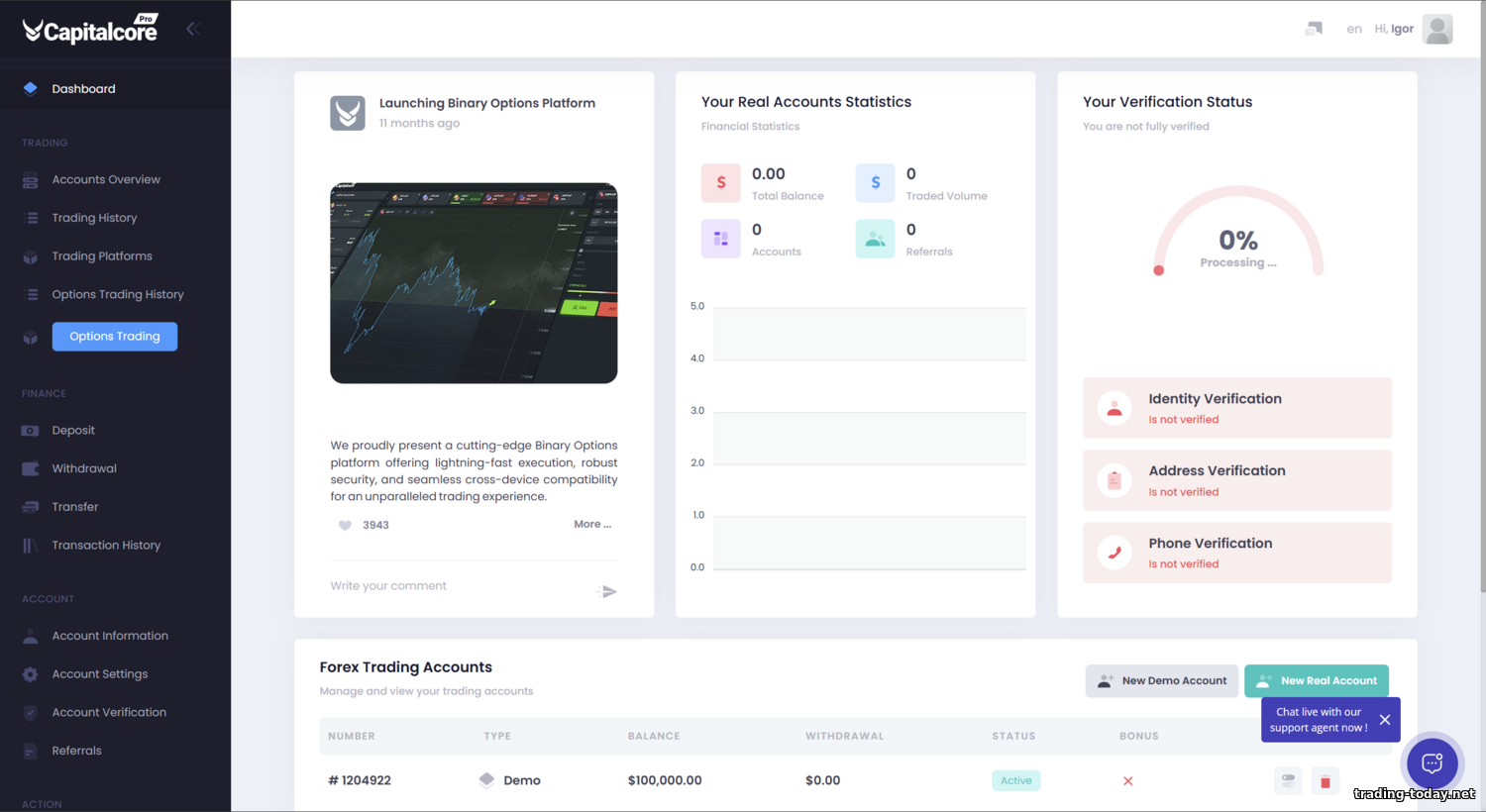
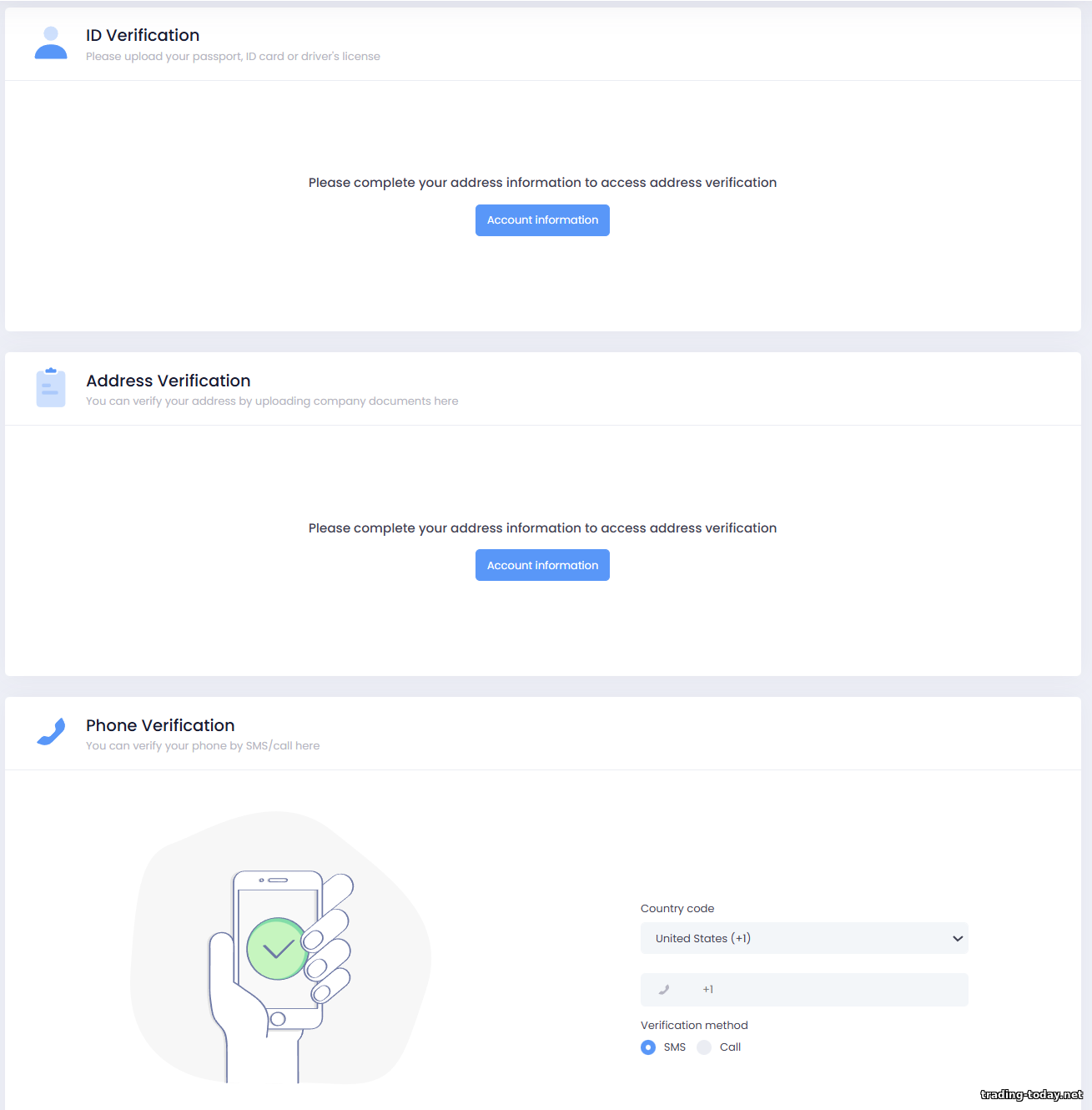
Is verification required to withdraw money? Yes—KYC is part of the process. Like most legitimate brokers, CapitalCore requires identity verification before the first withdrawal. Usually, this is a standard set: a government ID (passport or driver’s license) plus proof of address (bank statement or utility bill). Uploading is done through the client dashboard. Verification is often completed quickly—within about 1 business day, according to clients. For example, one user reported that an SMS confirmation did not arrive, and support called them and helped complete verification. This suggests the broker takes KYC seriously and is willing to resolve issues promptly. Withdrawals without verification are not allowed—this is a common industry standard, and CapitalCore is no exception.
Are there any limits or withdrawal issues mentioned in reviews? Most real feedback indicates that CapitalCore pays out consistently, and many users report multiple successful withdrawals without delays. Still, there are occasional complaints: someone waited 48 hours instead of 24, or someone was asked to resubmit documents for a larger amount. This can happen—offshore brokers sometimes become more cautious when clients withdraw bigger sums, requesting extra checks (proof of funds, etc.). So far, there are no widely documented cases of CapitalCore refusing to pay. That’s an important point: the public record looks relatively clean. However, keep in mind the general offshore risk: if the company disappears tomorrow, recovering funds could be very difficult. The strategy remains the same: don’t keep more on the account than you need for trading, and move profits to your own wallet regularly. In a worst-case scenario, that limits exposure to only a part of your balance.






Reviews and comments