
Cronika Broker Review – Straight Analysis: Cronika Scam?
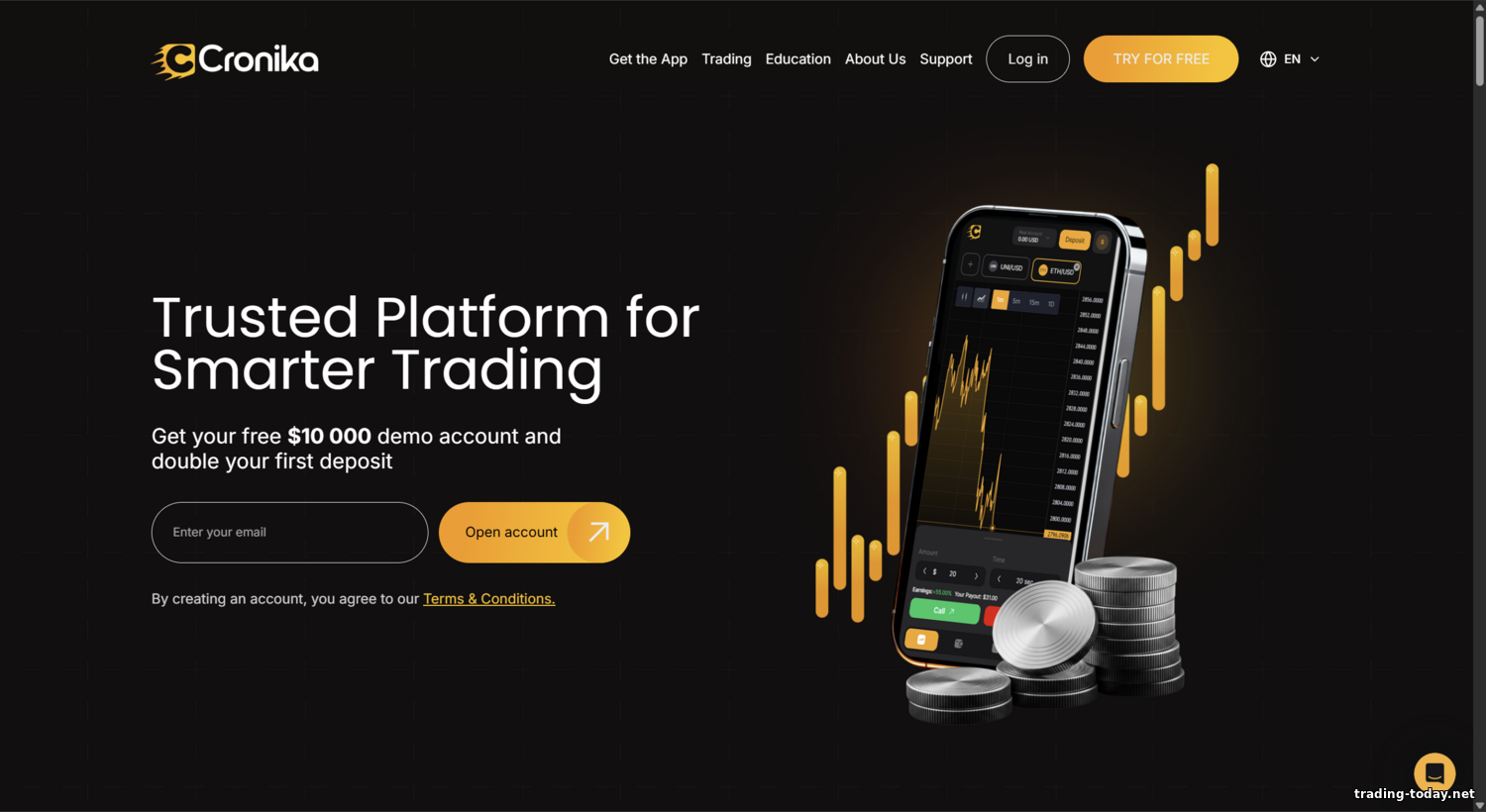
Cronika is an international online binary options broker offering simplified Call/Put (higher/lower) trading on currency pairs and cryptocurrencies. The company launched in 2025 and presents itself as a modern trading platform with a low entry threshold for traders worldwide. The broker claims registration in South Africa and mentions an FSCA license—the country’s financial regulator. However, a closer look shows Cronika operates with limited transparency: the official website lists neither the company’s legal name nor a physical office address.
Despite big promises about “smart trading” and convenience, Cronika looks like a typical offshore player in the binary options niche. The platform runs online in a browser and is also said to be available via desktop apps. Mobile support is advertised too—according to the site, there are Android and iOS apps—yet independent reviews question this (many can’t find a Cronika app in the App Store/Google Play and instead point users to a Telegram bot for mobile access).
Cronika is geared toward a fast start for beginners: a minimum deposit of just $10, a free $10000 demo account, trades from $1, and payouts on winning options up to 85%. The broker actively serves clients from different countries, especially across Asia and the CIS—USD accounts are available with conversion from local currencies (Pakistani rupee PKR, Indian rupee INR, Kazakhstani tenge KZT, and others). At the same time, users from certain countries are not served (for example, the United States, Russia, North Korea, Palestine, the Vatican, and others are on the restricted list). The platform’s official language is English, and there are no localized versions.
Cronika’s regulatory status raises questions. The company references the FSCA (Financial Sector Conduct Authority) in South Africa, but the broker’s site doesn’t provide clear, publicly verifiable details. Cronika doesn’t appear in FSCA lists of licensed firms, and a South African registration by itself does not guarantee investor protection worldwide (more on this in the reliability section). Overall, Cronika should be treated as an unregulated offshore broker, so caution is essential.
In this review, we’ll cover how Cronika works end to end: key pros and cons, trading terms and withdrawals, a check of the claimed FSCA regulation, and an assessment of reliability and reputation based on real feedback. We’ll also compare Cronika with competitors such as Quotex, Deriv, Pocket Option, Dukascopy—to understand how practical and safe it is to trade specifically on Cronika.
With 11 years of experience trading Forex, CFD, and binary options, I can say one thing: choosing a broker requires real care. Let’s break down what Cronika offers—and whether it makes sense to trust it with your money.
Contents
- Cronika at a glance: pros and cons
- Key strengths of Cronika: what attracts traders?
- Main drawbacks and risks when using Cronika
- Cronika regulation and reliability: what does an FSCA license actually mean?
- Cronika company transparency: registration, owners, reputation
- Cronika account types and the demo account
- Deposits and withdrawals on Cronika: methods, fees, timing
- Fees and trading conditions on Cronika
- Cronika bonuses and promotions: are there any reward programs?
- Cronika trading platform – features and limitations
- Cronika trading instruments: assets and markets
- Analytics and education on Cronika: is there any help for traders?
- Cronika customer support: quality and contact options
- Real trader experience and Cronika’s reputation
- Is Cronika suitable for beginner traders?
- Alternatives to Cronika – more reliable options
- FAQ – Frequently asked questions about Cronika
- Conclusion: is it worth working with Cronika?
- Key strengths of Cronika: what attracts traders?
Cronika at a glance: pros and cons
To form an initial impression of Cronika, here’s a compact summary of its key strengths and weaknesses. Below is a table that highlights the main pros and cons we’ll discuss in detail:
| Cronika advantages | Cronika disadvantages |
|---|---|
| Low entry threshold: minimum deposit $10, trades from $1. Suitable for beginners with a small budget. | No reliable license: no oversight from a top-tier authority. FSCA (South Africa) registration does not provide full investor protection. |
| $10000 demo account with no time limit: you can practice as long as you want before going live. | Low transparency: the site doesn’t publish clear legal details, and the owners are unknown. This hurts trust. |
| Convenient TradingView-based platform: an intuitive interface. | Limited asset selection: only ~15 FX pairs and 7–8 cryptocurrencies. No stocks, indices, or commodities—fewer diversification options. |
| 24/7 crypto trading: you can trade digital assets even on weekends. | No extra features: only classic “higher/lower” options. No early close, rollover, or copy trading. |
| Flexible funding: local payment methods (bank transfers via PayPort, UPI, JazzCash, etc.) and cryptocurrencies are supported. | Withdrawal and support issues: withdrawals are manual, delays are possible. Support can be slow, and chat often won’t connect you to an agent. |
| Quick registration and basic verification: the account can be opened in minutes, with minimal documents. | No education or analytics: no learning materials, signals, or an economic calendar. Beginners must learn on their own, increasing the chance of mistakes. |
| Fixed option payouts (~50–85%) make outcomes easy to understand: you know the potential profit in advance. | Lower payouts vs competitors: Cronika tops out at 85%, while some rivals reach 90–95%, which affects long-term profitability. |
| Weak fund protection: there’s no information about segregated accounts for client funds. In case of issues or bankruptcy, client money is not insured. |
As you can see, Cronika has clear strengths—accessibility, simplicity, and a modern interface. But there are also serious weak points: shaky regulation, limited features and assets, and questions around reliability and service speed. Next, we’ll go through these items in detail so you can decide whether Cronika is worth your trust.
Key strengths of Cronika: what attracts traders?
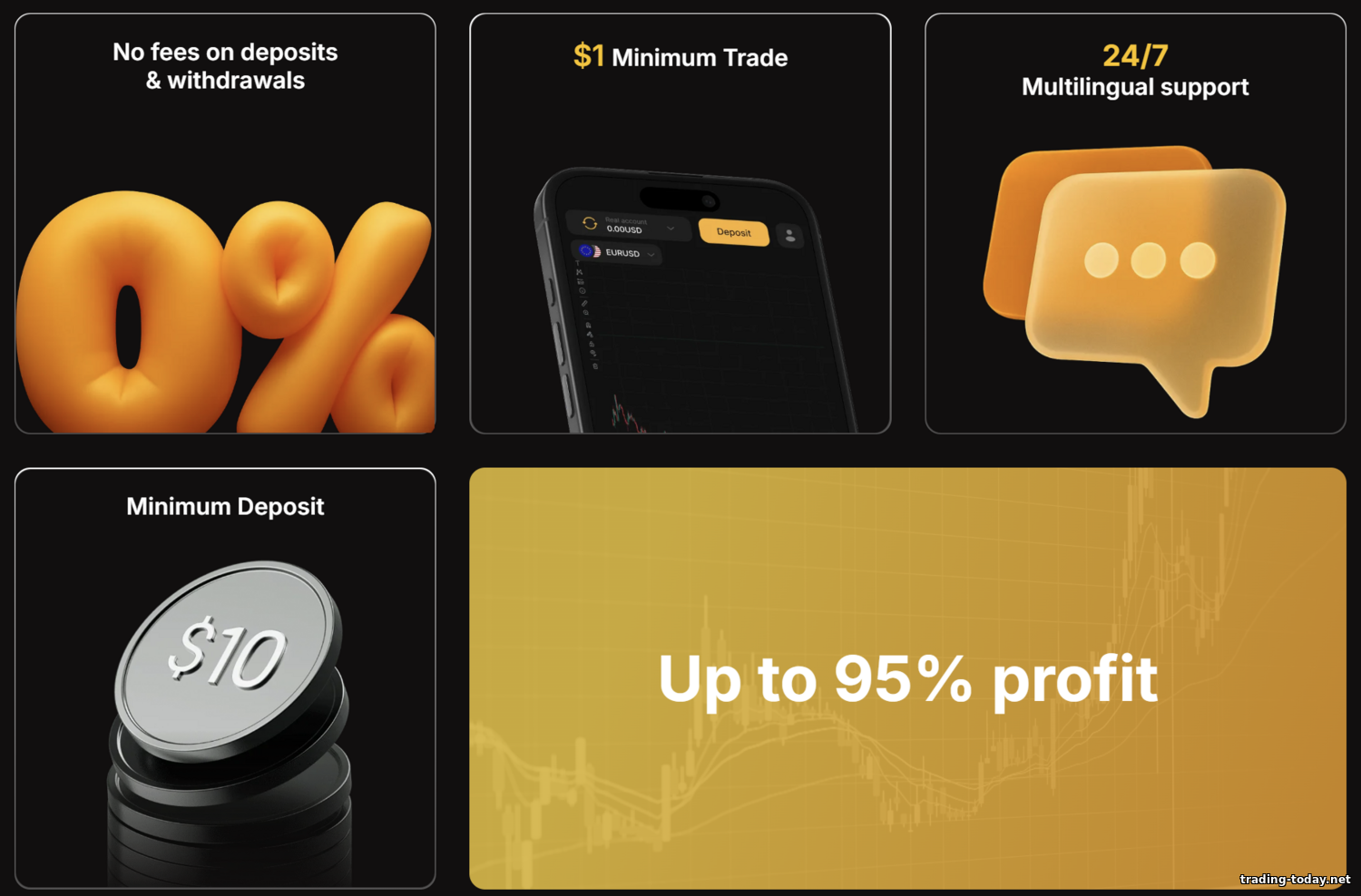
1. Low minimum deposit and a very easy start. Cronika stands out for its minimal requirements to begin trading. You can open a live account with just $10, and the minimum stake per option is $1. That’s one of the lowest entry thresholds in the industry. For comparison, many regulated brokers (especially in Europe) often require $100 or more to start. Cronika’s low barrier lets almost anyone try binary options trading without risking a large sum. Beginners commonly start with $10–$50 to test the platform, and Cronika clearly caters to that approach.
2. Free $10,000 demo account. After registration, each Cronika user gets a demo mode with a virtual balance of about $10000. The key point is that the demo is not time-limited: you can trade with virtual funds as long as you need to learn and test strategies. I always recommend that new traders “get a feel” for the market on demo first, and Cronika provides that option without aggressive restrictions. The demo is also available immediately with no deposit—according to the broker, you just press a button and can start practicing. That’s useful for beginners: they can explore the interface, test different assets and timeframes, and avoid risking real money.
There is one nuance, though: the demo balance is fixed, and if you blow the virtual $10000, restoring it can be tricky. Based on feedback, Cronika allows only one demo per email, and you can’t simply top up the virtual balance—you may need to create a new account or contact support to reset the demo. It’s an extra hassle (many competitors let you refresh demo funds in one click). Still, the fact that Cronika offers a free, unlimited-time demo is a definite plus.
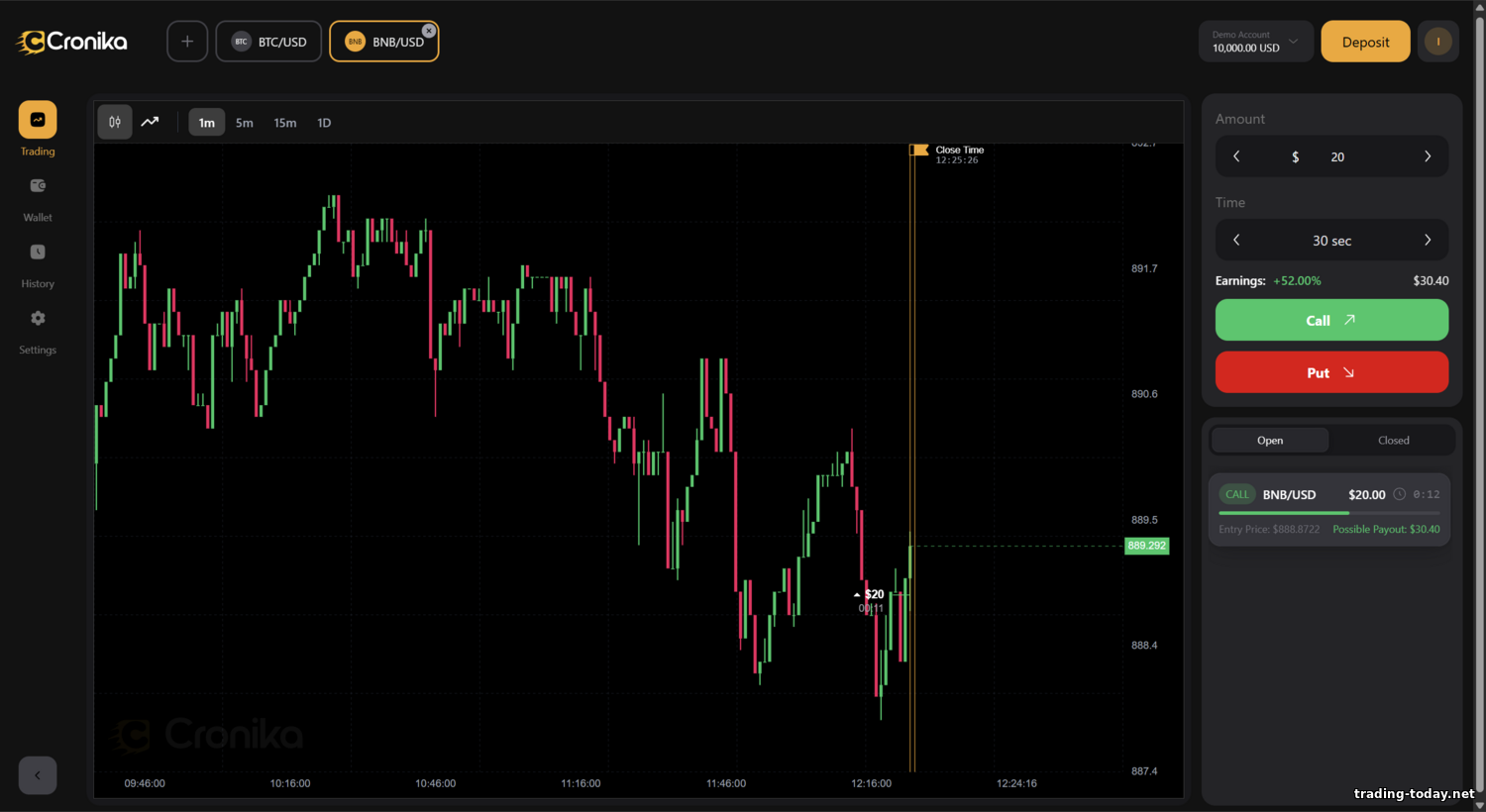
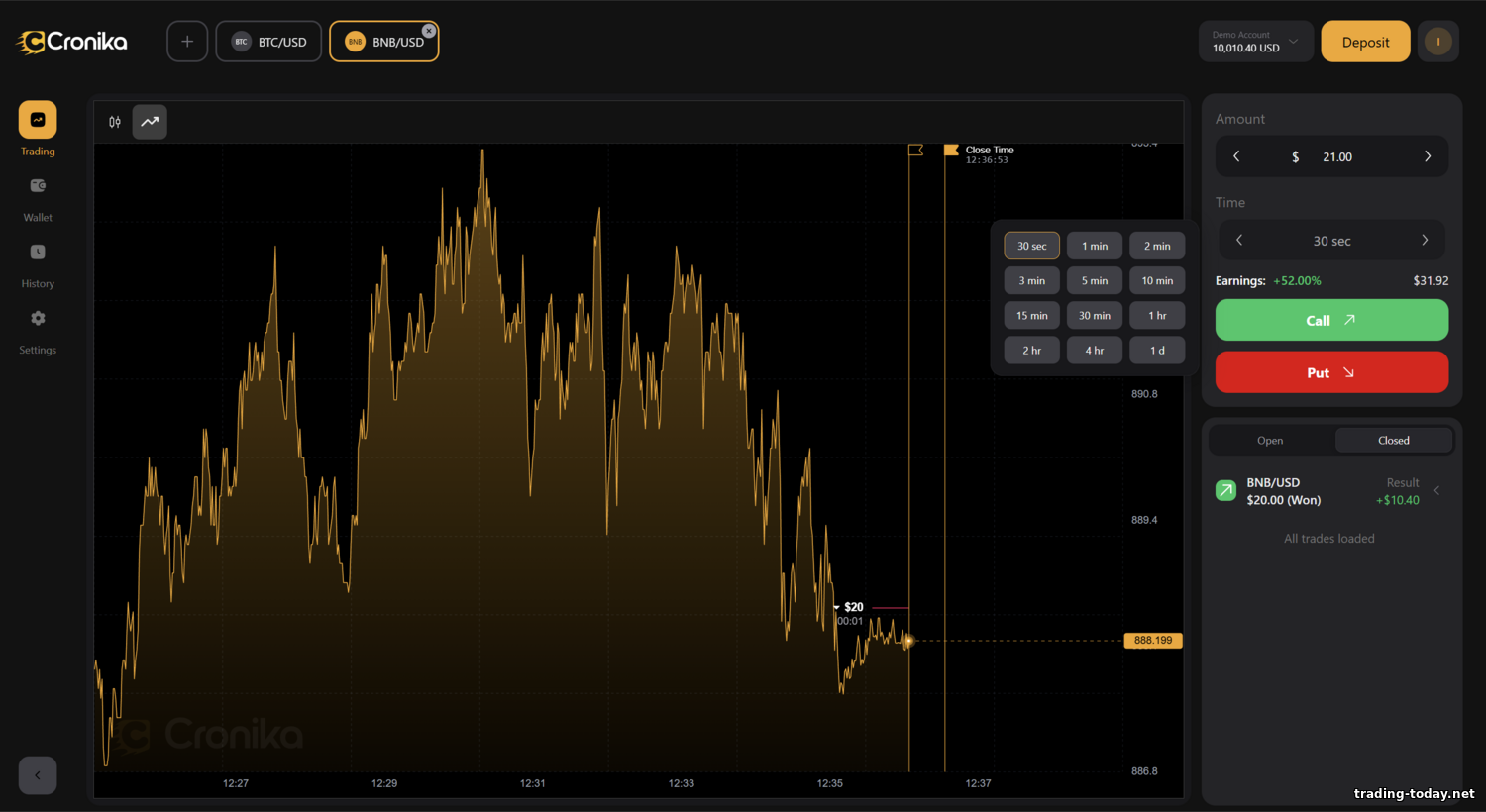
3. Simple, user-friendly trading platform (TradingView). Cronika built its own web terminal and integrated TradingView charts. In practice, this does not mean advanced charting—there are no indicators or drawing tools here. The interface is straightforward even for a beginner: the chart takes the center of the screen, the asset selector is on top, and the trade panel is on the right (Call/Put buttons, stake amount, and expiry time selection).
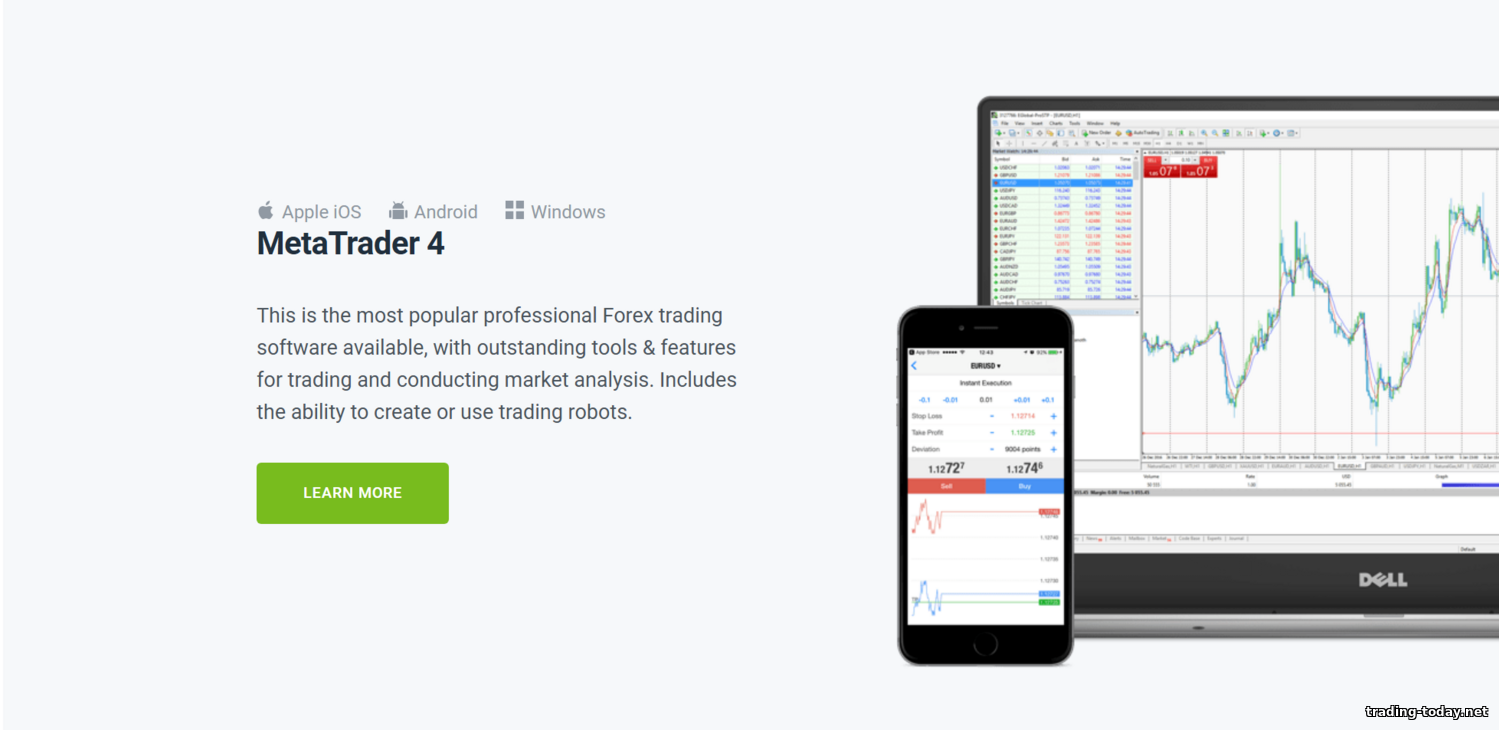
The platform works directly in a browser and does not require installation, but desktop apps for Windows and Mac are also mentioned for convenience. There’s even a claim of Android/iOS downloads, suggesting broad device coverage. In reality, a Cronika app may not be available in standard app stores; however, you can trade via a mobile browser—the interface is adapted for smartphones. Overall, Cronika’s terminal is built around simplicity and speed: trades open instantly, and the UI is not cluttered with extra features.
4. Straightforward fees and clear conditions. Cronika states there are no per-trade commissions—no spreads and no hidden charges per option. What a trader pays is simply the stake amount (if you lose, you lose it; if you win, you get the stake back plus profit). Profit is fixed: ~50% on major assets and up to 85% on select cryptocurrencies. That means you know the potential return before opening a trade. For example, if you invest $100 and correctly predict the market move, you receive $185 (with $85 net profit). If you’re wrong, you lose the $100 stake. This model is easy to understand—no floating coefficients and no complex calculations. Cronika also claims there is no inactivity fee (inactivity fee = $0), so you shouldn’t see silent deductions if you don’t trade for a while. The broker does not actively push bonuses either, which reduces the risk of “bonus turnover” rules blocking withdrawals—your funds aren’t tied to volume requirements. Cronika also highlights “No fees on deposits & withdrawals.” In reality, a 0.5% withdrawal fee is often mentioned (see the withdrawals section), but this is still relatively small. For small accounts, Cronika’s pricing clarity is a meaningful advantage: you can trade modest stakes without feeling that fees will eat your balance.
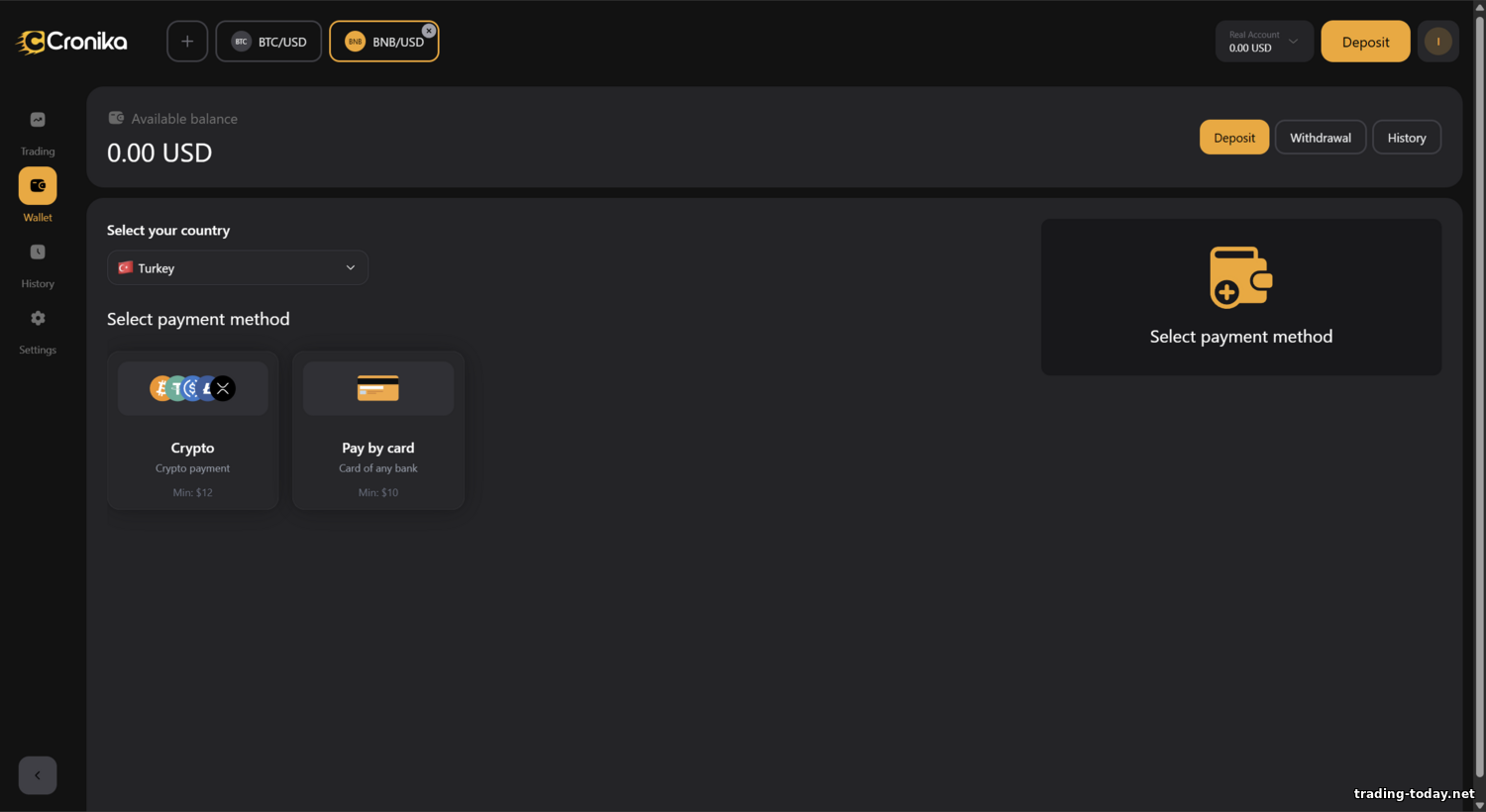
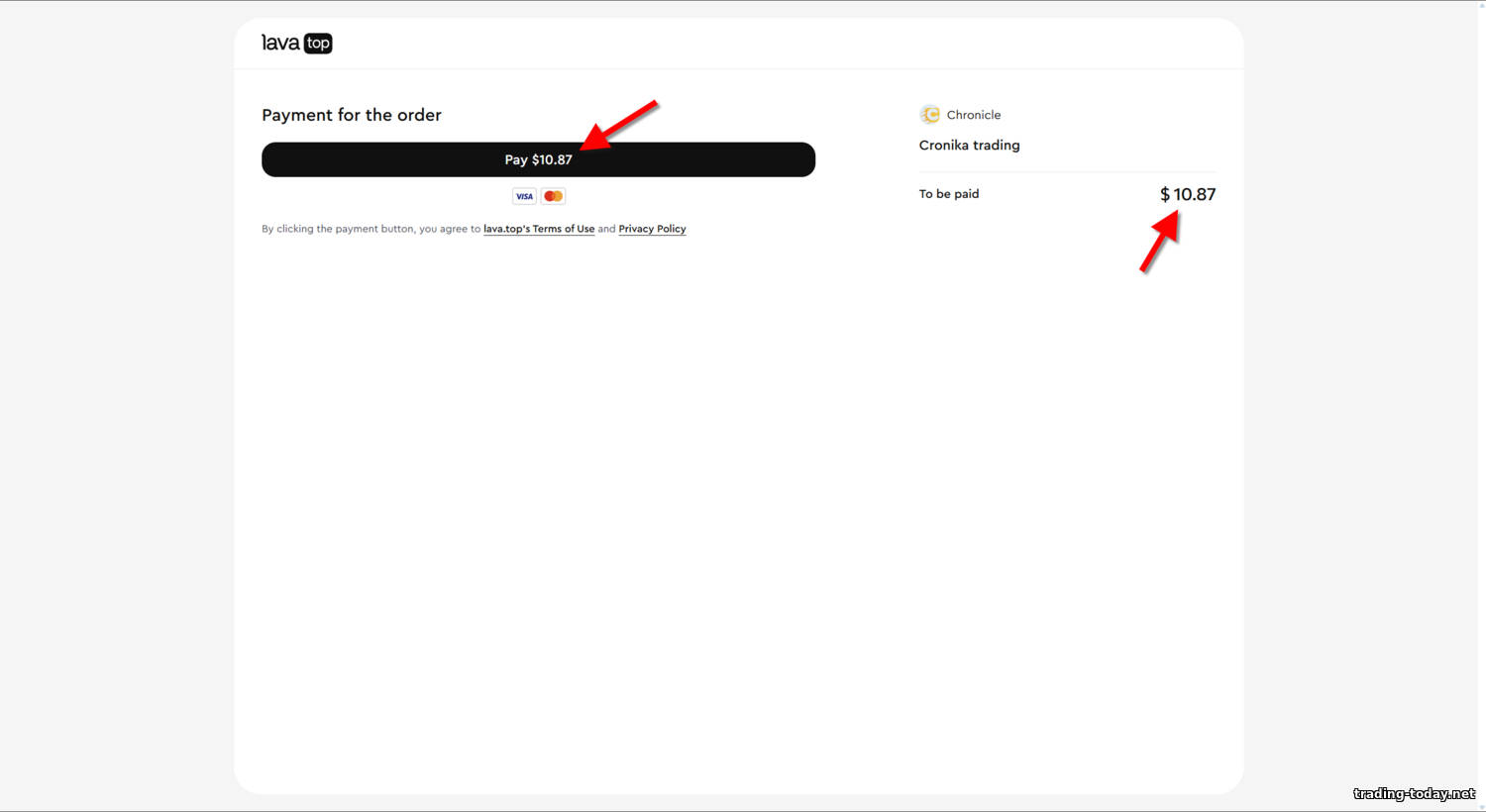
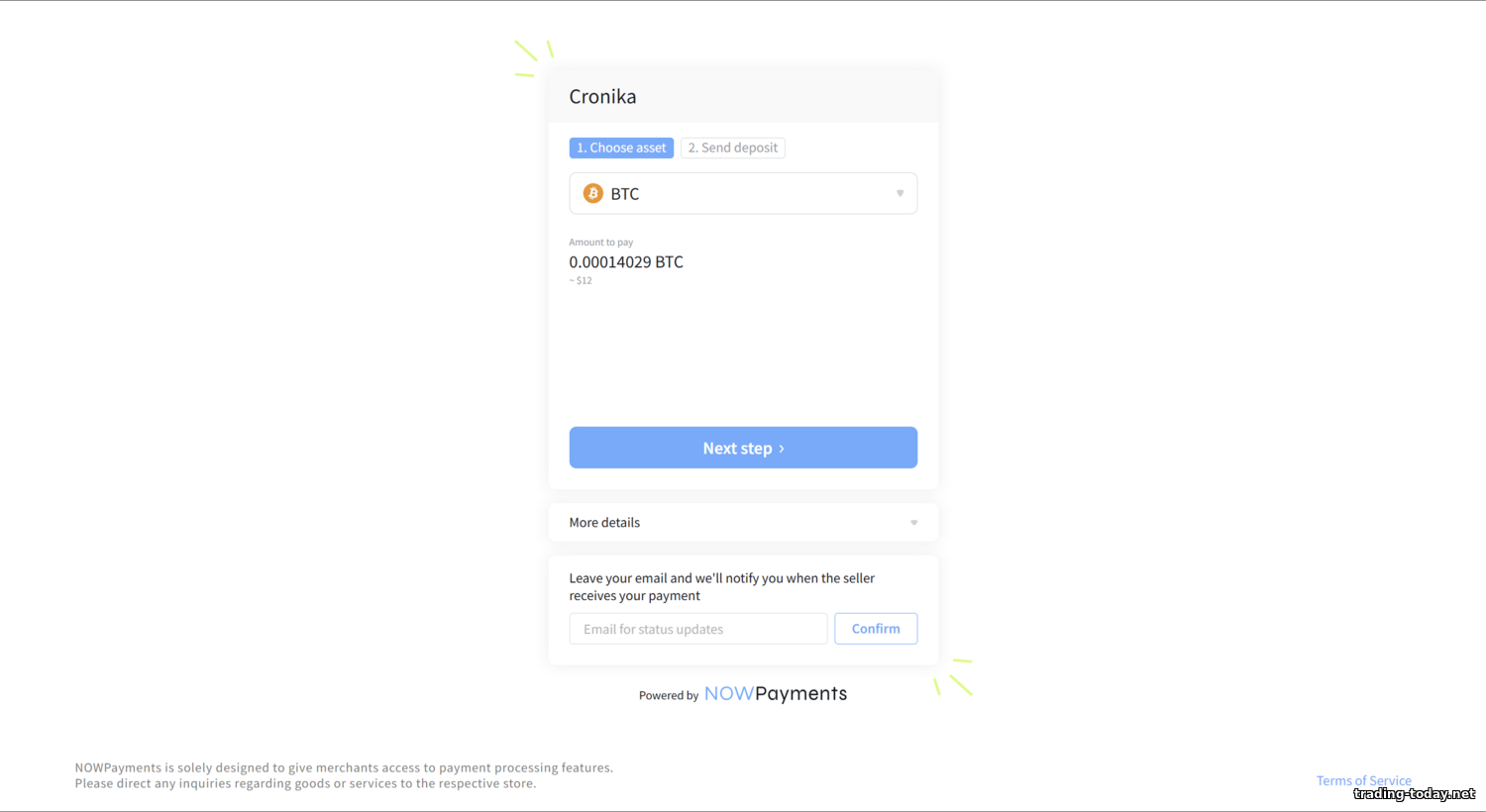
5. Fast funding and local payment methods. Even though Cronika is an offshore broker without strong presence in markets like Russia or Europe, it tries to make funding convenient for clients in different countries. Deposits are available via PayPort—a service that lets you transfer funds that are then converted into USD and reflected as your local currency (PKR, INR, KZT, etc.) without an additional conversion charge. In simple terms, you can make a bank transfer to the PayPort account provided by the broker, and the money is credited to Cronika in dollars. Cronika also supports a wide range of cryptocurrencies for deposits: according to the website, Bitcoin (BTC), Ethereum (ETH), Tether (USDT), USD Coin (USDC), Litecoin (LTC), DAI, and other popular coins are available. Crypto payments are routed through the external gateway NOWPayments, which processes transactions.
It’s worth noting that Cronika emphasizes local payment options for Asian countries: for example, support is claimed for India’s UPI, NEFT, RTGS, Pakistan’s JazzCash, EasyPaisa, and others. This means traders in these regions can fund accounts through familiar domestic payment rails rather than complicated international transfers. That can genuinely help beginners: not everyone has an international card or a crypto wallet, but many people do have access to a local bank or mobile wallet.
Overall, funding a Cronika account can be relatively simple and quick. The $10 minimum deposit makes it even less burdensome. If you have, say, 1000 rubles or 7000 tenge, PayPort can turn that into roughly $10 on your Cronika balance. Based on reviews, deposits often show up within a few hours (and sometimes almost instantly) when everything is done correctly.
6. 24/7 trading and fast execution. Cronika allows trading 24 hours a day, 7 days a week—at least on cryptocurrencies, which trade without weekends. Traditional Forex pairs are available on weekdays (like the interbank market), but the broker offsets weekend downtime with round-the-clock crypto options. As a result, traders can operate almost anytime, which appeals to active speculators and people who combine trading with a day job. Users also mention quick execution on Cronika—often praising the platform for minimal lag. I tested a few trades myself: Call/Put orders opened instantly, without freezes, and the chart updated smoothly. Binary options are generally less execution-sensitive than scalping Forex, but speed still matters—especially on short timeframes. In that sense, Cronika performs well: the terminal feels stable and responsive, and some users say the platform “loads quickly” and “works reliably.” For short-term traders, execution speed helps ensure a trade opens at the expected price and closes precisely at expiry.
7. No heavy bonus marketing. At first glance, the lack of bonuses may sound odd as an “advantage,” since many brokers attract clients with generous promotions. But in the binary options niche, bonuses often come with strings attached: once you accept a deposit bonus, you may have to meet a large turnover requirement before you can withdraw money. That can trap traders and often ends with the account being wiped out before the conditions are met. Cronika takes a different route—no classic bonuses, tournaments, or contests are prominently offered. This “no bonuses” policy can be a plus: you’re free to withdraw your funds without chasing turnover targets. It also reduces the temptation to deposit more just to get a bonus and then struggle with restrictions.
To be fair, Cronika’s homepage sometimes shows a “double your first deposit” message. This may be a short-term promotion or a marketing element, but detailed terms are not always clear. Either way, at the time of writing, there is no dedicated bonuses section on the site and no stable, publicly described promo program. So it’s reasonable to say Cronika doesn’t rely heavily on bonus-driven acquisition. Some users may find that boring, but from a risk perspective it can simplify withdrawals and reduce unpleasant surprises.
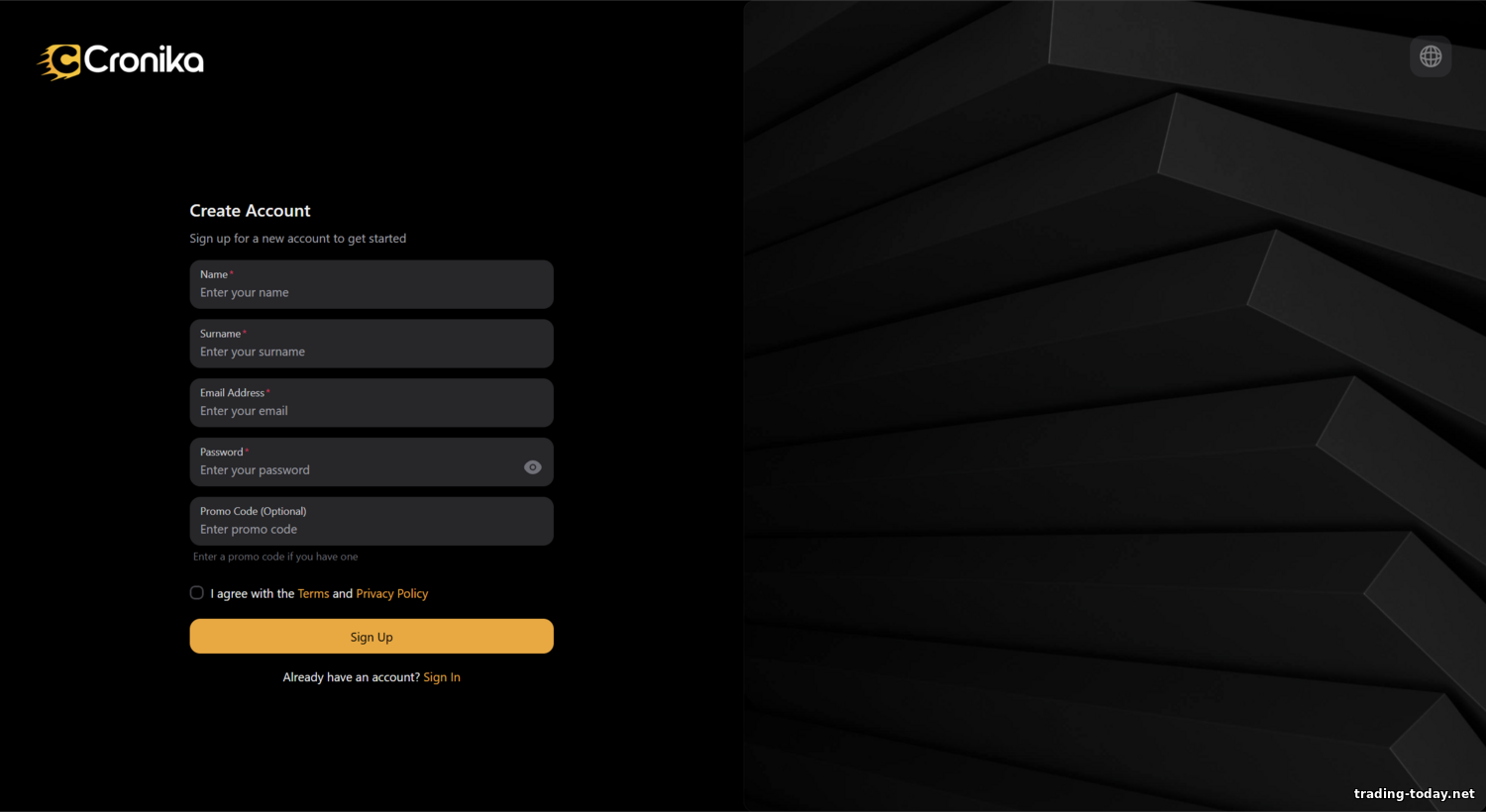
Of course, these points don’t cover everything. You can also mention the fast sign-up (the broker says “1 minute,” and that’s fairly close), and the multi-device approach (trade from a PC, or use web access on a phone, including via Telegram). Combined, the advantages make Cronika an accessible starting point for those who want to try binary options with minimal capital. However, the drawbacks and risks are also serious—let’s look at them in detail.
Main drawbacks and risks when using Cronika
Despite some appealing features, Cronika has significant downsides that traders should understand upfront. Some of these issues can directly affect fund safety and the overall trading experience. Below are the key weaknesses of Cronika:
-
1. No strong regulation or reliable licensing. The biggest concern around Cronika is legal reliability. In practice, the broker is not regulated by major financial authorities in Europe, the US, or Asia. The claimed FSCA status in South Africa does not inspire much confidence. FSCA is a regulator that can register companies offering financial services, but oversight of binary options is widely seen as limited. More importantly, we could not find Cronika in public lists of licensed FSCA providers (it’s possible this is only a basic company registration in South Africa without FSP status). In the binary options industry, many fraudulent brokers operate without any meaningful license, and Cronika looks closer to the offshore segment than to a fully regulated environment.
Lack of regulation is a major risk: client funds are not protected in a robust legal framework. There is no assurance Cronika keeps client money in segregated accounts rather than using it for operational needs. There is no compensation fund—if the broker collapses, you won’t receive insurance. There may be no competent supervisor to file a complaint with in a dispute—such brokers are not overseen by the Bank of Russia, Europe’s ESMA/FCA, or the US CFTC. Also, binary options are banned in some jurisdictions (for example, the UK FCA banned the sale of binary options to retail investors in 2019 as a high-risk product often linked to fraud). Cronika operates outside these legal fields, which is a red flag in itself.
In practical terms, if you run into withdrawal problems or disputes over trades, you may be left alone with the company. There is no regulator that can compel Cronika to return your money. As an experienced trader, I’m very cautious with unregulated online brokers: too often, a “platform” turns out to be a pure scam operation. Cronika has not been tied to major scandals yet, but the risk of unfair behavior is high. The broker can change payout percentages at will, display questionable quotes, or refuse to process profits, and holding it accountable may be close to impossible. That’s why the lack of a solid license is the single biggest drawback of Cronika and should make any trader think twice.
-
2. Near-total lack of transparency about the company. Cronika discloses very little about itself. On the website you won’t find a legal entity name, management or ownership details, or a clear office address. The only thing that surfaces in some sources is that the broker claims to be registered in Durban, South Africa—but this is not clearly documented on the company side. In Cronika’s “About Us” section, there are mostly generic statements, and there’s even a strange mention of growth by 2017 despite the platform launching in 2025. This information gap is a warning sign. Reliable brokers typically publish license numbers, registrars, headquarters addresses, and direct contact options beyond an email. Cronika does not.
This naturally raises the question: could this be a scam? When a company openly shows its name and address, trust increases. But when a broker behaves like a “grey cardinal”—here today, gone tomorrow—it resembles the playbook of dubious bucket-shop operations. In the trading community, Cronika is still not widely known: there aren’t many strong positive reviews, but there aren’t many major investigations either. On forums, information is limited and many traders say they’re hearing the name for the first time. A new broker without an established reputation is always risky—you’re effectively testing a newcomer with your own money.
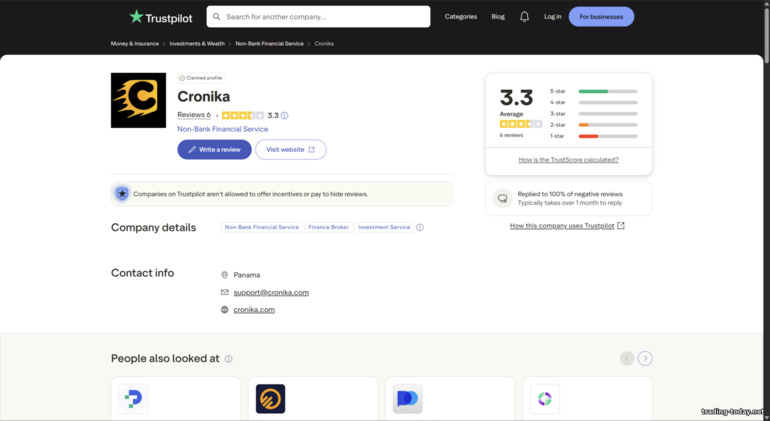
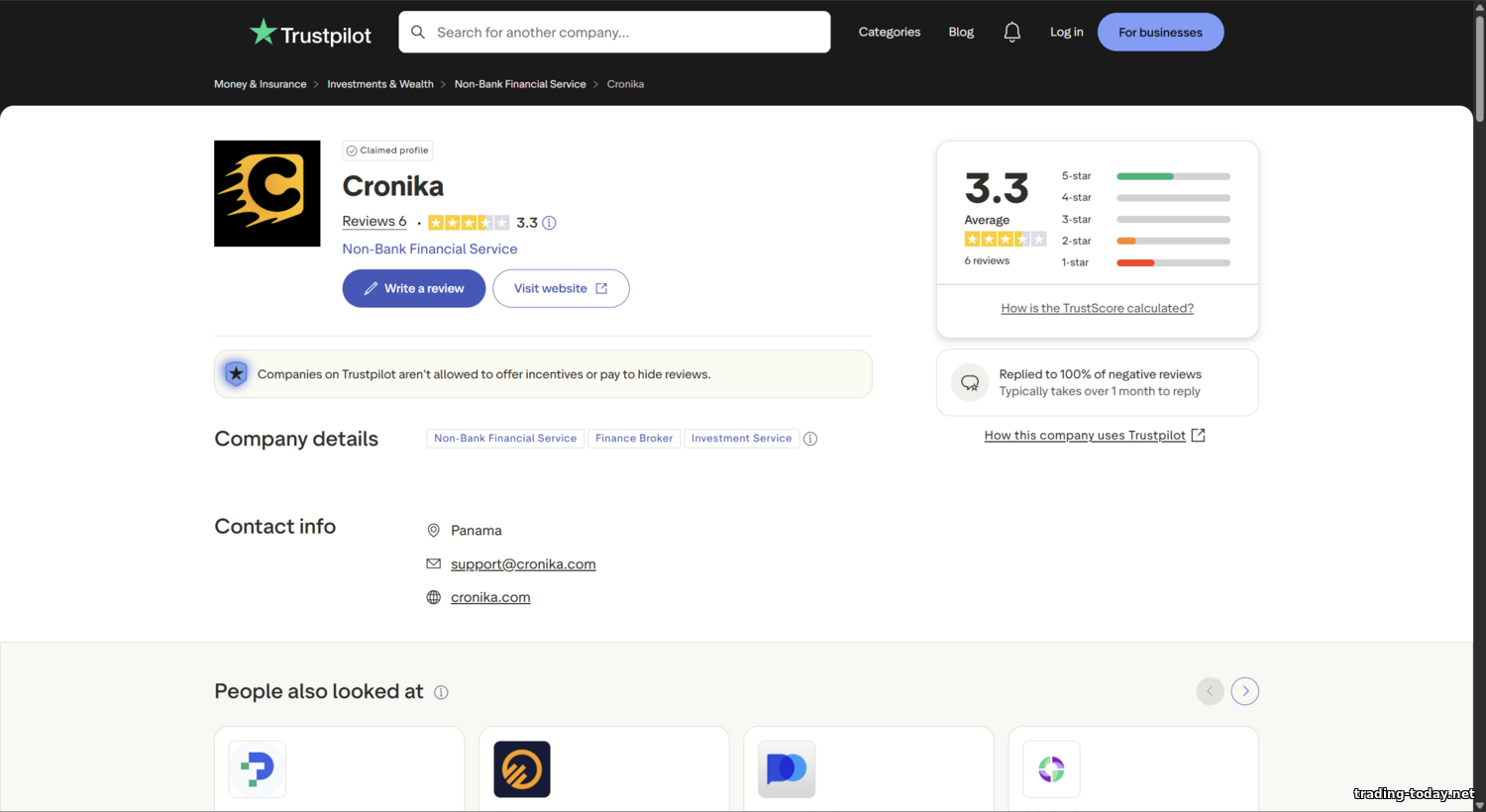
Still, we did find a small amount of feedback. On Trustpilot (a popular review site), Cronika’s profile is unclaimed and shows only 2–3 reviews from mid-2025. The average rating is around 3.5 out of 5, i.e., neutral. One user from Malaysia complained that a deposit was credited very slowly—money appeared on the trading balance only after 4+ hours, and only after the user posted a negative review. Another user, in contrast, gave 5 stars for a “modern interface and convenience.” In comments on one English-language site, a story appeared where a trader couldn’t withdraw $280 in profits—the withdrawal request stayed pending with no resolution, and support didn’t help (the person ultimately received nothing). Such complaints are concerning: non-payment scenarios may happen. Cronika does not appear to respond publicly to negative feedback (the Trustpilot page is not moderated by the company and there are no representative replies).
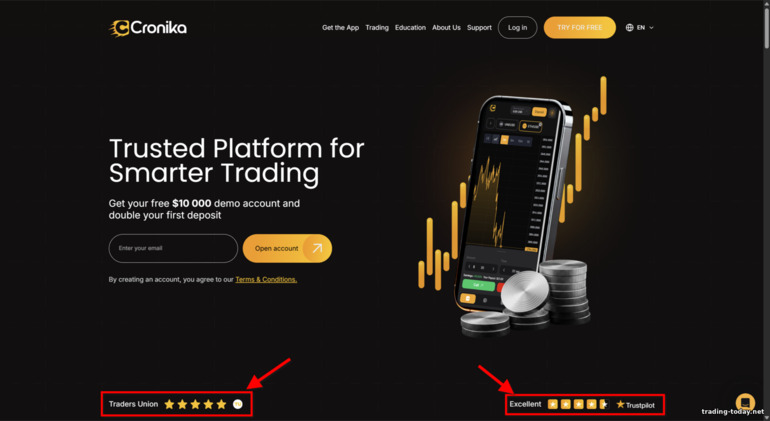
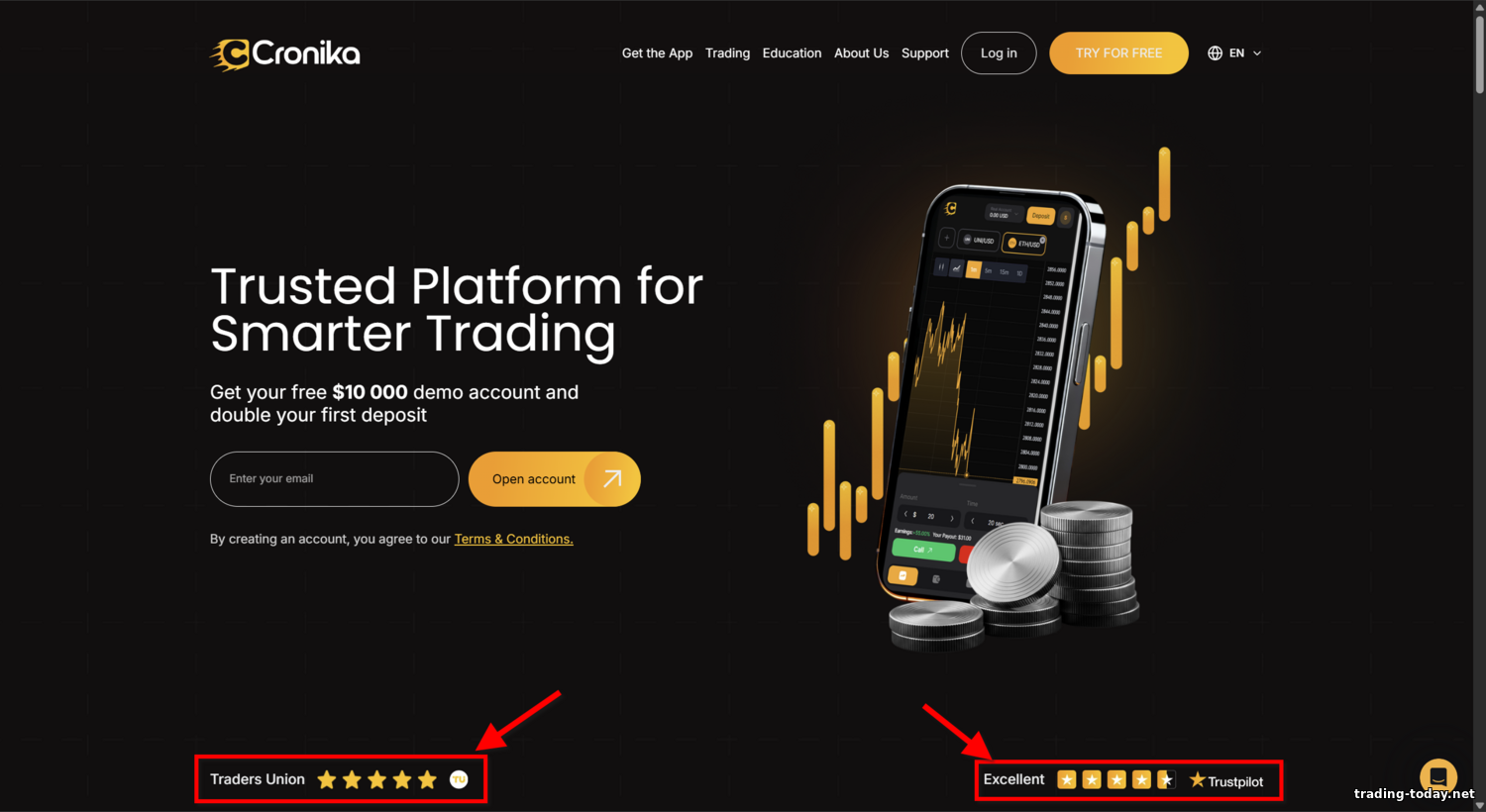
In addition, Cronika’s website shows a high rating from Traders Union, but Traders Union does not have a published review of Cronika. From this, I draw a simple conclusion: the broker may be misleading users by implying endorsement from an authoritative resource that does not actually cover it.
Overall, Cronika’s reputation remains questionable. There’s no definitive proof of outright fraud, but there are cases of dissatisfied users. And given the offshore nature of the service, that risk can grow over time. In this area, Cronika clearly trails competitors that have been around for years and earned the trust of large user bases.
-
3. Limited functionality and a narrow set of assets. Cronika’s platform, while simple, offers minimal capabilities. Traders get only one contract type—classic “Higher/Lower” binary options with fixed expiry. There are no other option formats (such as range or ladder), which some platforms offer. Every trade is a short-term bet on price going up or down. Expiry times are limited from about 20 seconds to 4 hours. Longer-term options (day/week) are not available. This automatically pushes Cronika toward very short-term, scalping-style trading. Not every trader likes or can trade such small intervals—many prefer calmer approaches that are not supported here.
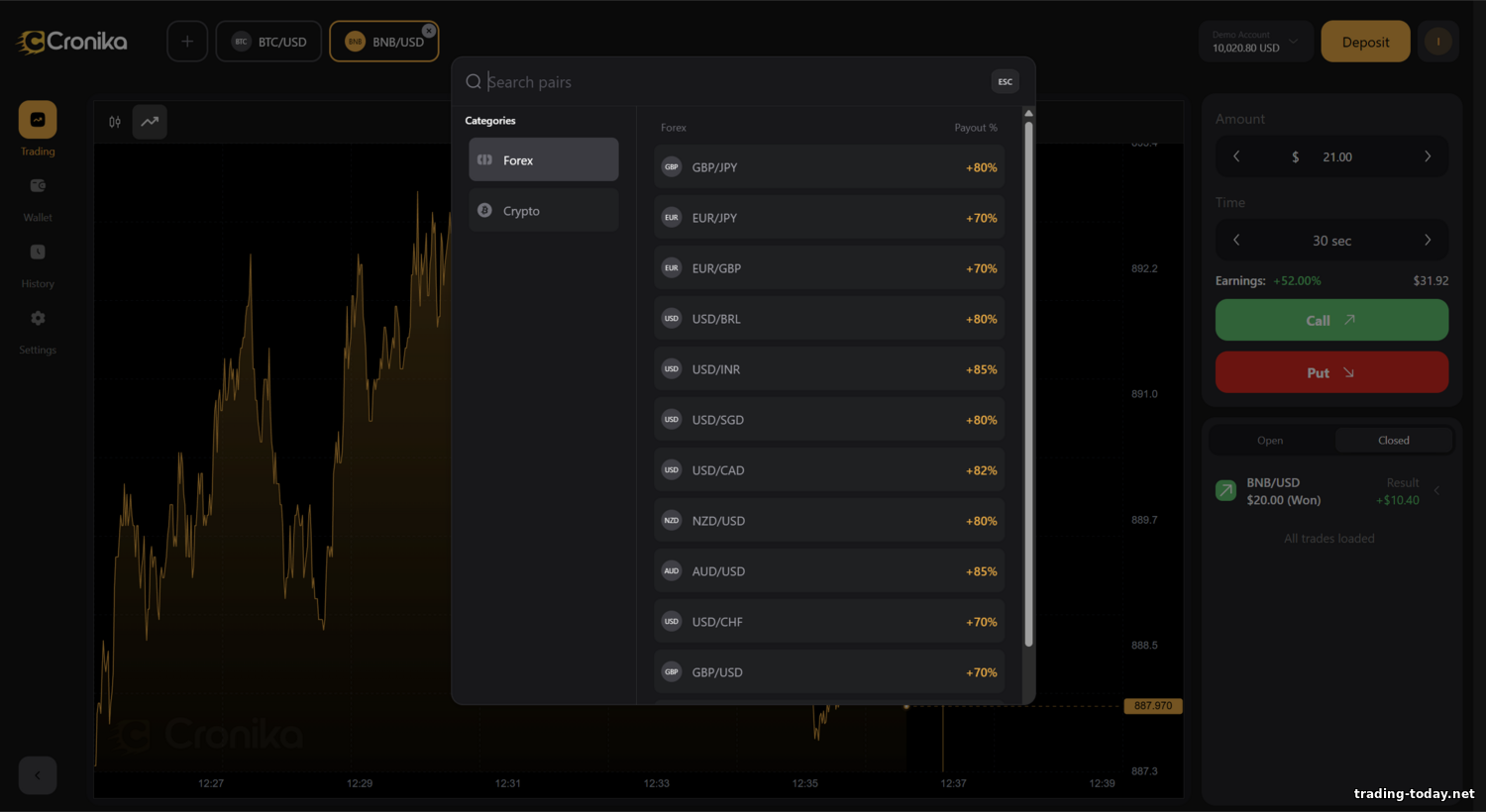
The choice of instruments is also quite narrow. Cronika lists roughly 22 assets in total: around 14 Forex pairs and about 8 crypto pairs. The FX list is mostly majors like EUR/USD, GBP/USD, USD/JPY, AUD/USD, plus a few others against the US dollar. There are no exotic pairs (like USD/TRY or cross pairs without USD), and there are no metals (XAU/USD) or oil. Cryptocurrencies are mostly popular coins against USD: BTC/USD, ETH/USD, LTC/USD, XRP/USD, SOL/USD, BNB/USD, ADA/USD, USDT/USD, and similar. There are no stocks, indices, ETFs, or commodities. By comparison, some competitors (Quotex, Pocket Option) offer dozens of stocks, indices, and commodities, enabling better diversification. Cronika stays focused on Forex and crypto, and even then the list is short.
On top of that, there are no advanced trade-management tools. You can’t close an option early to lock in profit or cut losses—you must wait until expiry. You can’t extend expiry (“rollover”) or increase stake mid-trade—features that exist at some binary brokers but are missing here. There’s also no copy trading (automated mirroring of other traders’ trades) and no built-in algorithmic strategies. Cronika is a very basic level of trading, without add-ons. For beginners this simplicity can be a plus, but for experienced traders the feature set will feel thin. Personally, I’m used to having market news, at least an economic calendar, and some analytics—Cronika provides none of that.
As a result, Cronika won’t suit traders who want variety. If you want to trade more than FX and crypto—such as stocks or oil—this broker won’t offer it. If you need flexible conditions (multiple option types, longer horizons), it’s also a miss. The platform is built for short-term speculation on a small set of assets, and that limitation is significant. An experienced trader with a larger deposit will usually choose a platform with broader market coverage than Cronika with its ~20 instruments.
-
4. Deposit/withdrawal issues and manual processing. While we mentioned local payment options as a plus, the deposit and withdrawal workflow at Cronika is far from ideal.
Another drawback is that deposits are not always instant. In practice, after sending a transfer a trader may wait several hours before funds appear on the Cronika balance. That’s inconvenient: today we’re used to card deposits or at least crypto confirmations within 10–20 minutes. Here, manual checks increase the chance of delays and mistakes (for example, if you enter the wrong payment note, money can get stuck).
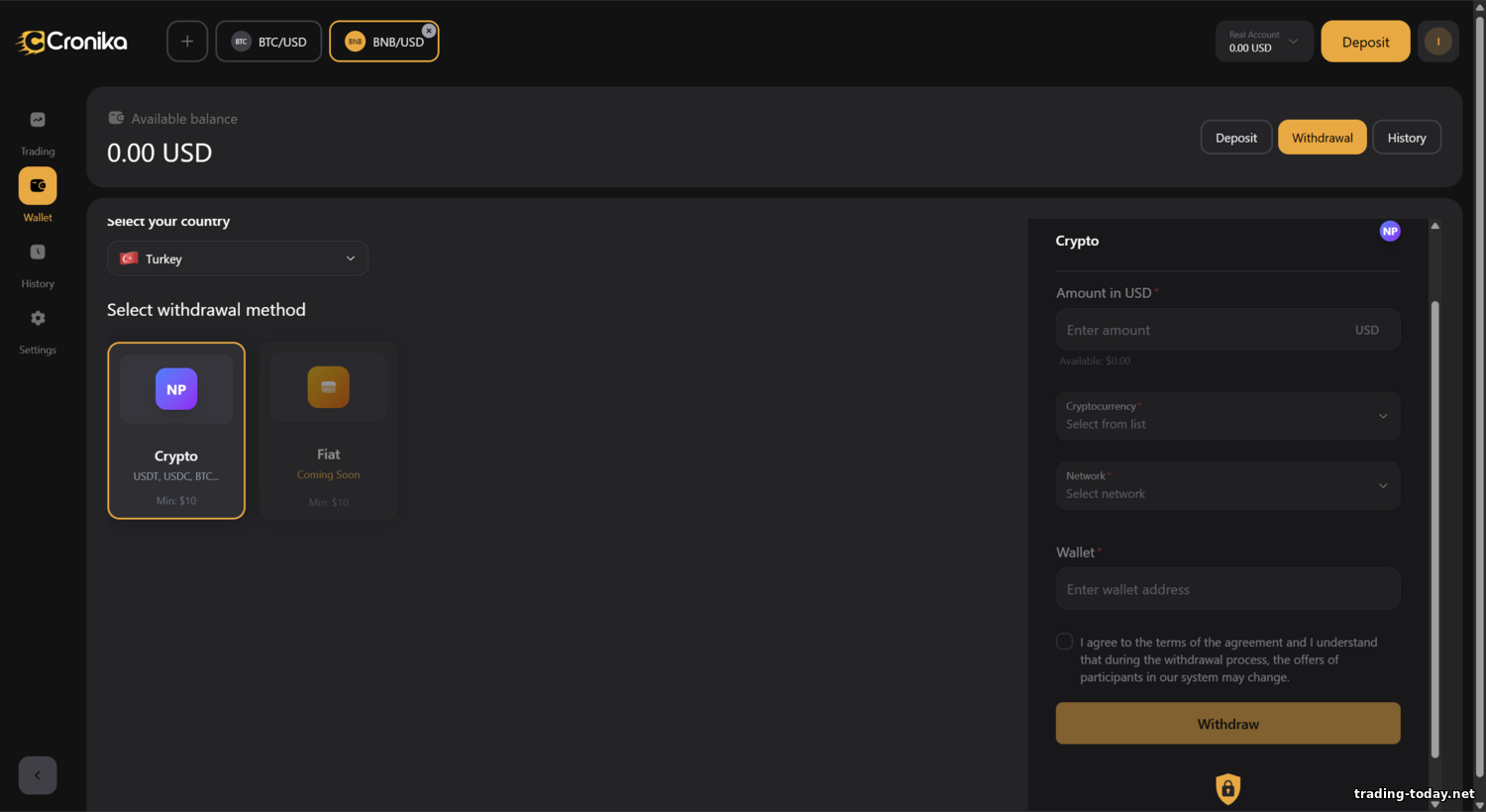
Withdrawals are similar. The minimum withdrawal is $10, and Cronika charges a 0.5% fee. Formally it’s small (for example, from $100 you receive $99.5), but the presence of a withdrawal fee still means the broker earns on transactions as well. Withdrawal requests are processed manually by Cronika’s finance team. The stated timeframe is 1 to 3 business days, but it can take longer. Funds are typically paid out in cryptocurrency. You may also have to wait for manager approval. Some users report that unless they remind support, the request can sit untouched—until you message them, nothing moves. There is little automation; the outcome depends on how the staff handles it.
Overall, Cronika’s payments handling lags behind the best practices in the industry. While many platforms now offer fast card withdrawals or stablecoin payouts, Cronika often operates via an old-school manual flow. For traders, this means being ready to wait—and potentially worry—when it’s time to withdraw profits. Personally, I always pay attention to how simple and predictable financial operations are; with Cronika, this area is, unfortunately, average at best.
-
5. Weak customer support and no localization. Another serious downside of Cronika is client service. Support is available only via live chat and email. There’s no phone line, no local offices, and no callback service. At the same time, testing suggests Cronika’s live chat is largely bot-driven. You open the chat, get an auto-reply with generic prompts, and when you try to reach a real agent, it says an operator will join soon—yet in practice nobody connects. In one test, we waited over 5–10 minutes with no response. Trying again at another time produced the same outcome. This raises doubts about whether true 24/7 support exists, even though the site claims “24/7 multilingual support.”
On language support: “multilingual” seems overstated. Cronika targets an international audience, but communication is primarily in English. Staff may use a translator for simple questions, but expecting a support agent to speak your language reliably is unrealistic. For traders who don’t speak English, explaining issues to Cronika support can be difficult.
The on-site FAQ is very thin—mostly basic questions like “how to deposit” or “how to close a trade.” There are no expanded help articles or detailed guides. So with any non-standard issue, users have to write to chat or email—and there, they may face silence or unhelpful bot responses.
This level of support doesn’t hold up well. Stronger brokers invest in service quality: personal managers for VIP clients, prompt handling of withdrawal cases, and real platform assistance. Cronika has little to show here. Some reviews say support doesn’t solve withdrawal problems—either emails are ignored or the response is a generic “please wait, your request is being processed.” For traders, that’s frustrating: being stuck without help when funds don’t arrive or something breaks.
On the plus side, Cronika has social media presence (Instagram, X (formerly Twitter), YouTube), but these channels look more like marketing than actual support. Some reviews mention irregular posting and little practical assistance. So relying on alternative contact channels doesn’t seem realistic.
In summary, Cronika’s support leaves a lot to be desired. For simple tasks (like “how do I change my password”), you may not need help. But if something serious happens—such as a withdrawal being stuck—you may spend a long time trying to get a real response. One user story sums it up: “the chat kept asking me to confirm my email but never connected me to a person—it was very annoying and prevented me from getting help on time.” That’s far from a client-focused standard.
-
6. No education or useful resources for traders. As noted earlier, Cronika does not provide educational content. There’s no learning section with lessons, videos, or trading articles. There isn’t even a built-in economic calendar or market news feed. In other words, the broker offers only a basic trading interface, and everything else is “figure it out yourself.”
For beginners, this is a meaningful drawback. Many new traders expect at least foundational guidance from a broker: what binary options are, how to read charts, and which strategies to try. Serious companies often have full education hubs with courses and webinars, sometimes even personal coaching for larger accounts. Cronika offers none of that—no signals, no analytics, no structured learning. A novice is left alone with a TradingView chart and must search for information elsewhere, learn from YouTube, and read books.
At the start of a trading journey, lack of knowledge is critical—based on experience, inexperienced traders often blow up deposits by making basic mistakes. A good broker at least tries to educate users, because long-term success benefits everyone. Cronika doesn’t seem interested in investing in that side—perhaps the expectation is that beginners will come, trade small sums, and either lose or leave quickly. In that sense, the platform can look like a short cycle of “deposit–trades–loss.”
Of course, experienced traders may not care about training. But since Cronika clearly targets newcomers (low entry threshold, demo account, simple UI), it would make sense to include at least basic education. By not providing it, the broker indirectly increases the likelihood of client losses (without risk management and technical analysis basics, people tend to lose faster). A trader who loses may leave—or deposit again—which may suit the broker. From a long-term trust standpoint, this approach doesn’t help Cronika’s image.
-
7. Lower maximum payouts on options. Another relative downside is that Cronika’s payouts are typically capped around 50–85%. Yes, fixed numbers offer predictability. But when compared to competitors, the difference is obvious: some platforms offer up to 90–95% on popular assets (for example, Quotex – up to 95%, Pocket Option often reaches 90%, Binary Cent may show 85–90%, etc.). The gap may look small, but over time it matters.
Think about it this way: with the same stake size, a payout of 80% yields less profit than 90%. That means Cronika keeps a larger “edge,” and your strategy needs a higher win rate to be profitable. A system that is slightly profitable at 90% can become unprofitable at 80%. This is especially important for active traders with a high volume of trades—several percentage points can meaningfully reduce potential earnings.
Cronika may advertise “up to 95% profit” on the website, but in practice such numbers are either rare or tied to unusual conditions (for example, a specific asset at low-liquidity hours). In reality, most contracts on Cronika tend to show around 80% for FX and up to 85% for crypto. This is consistent with platform tests and my own observations. So 95% looks more like a marketing ceiling than a common rate.
As a result, Cronika traders often start in less favorable conditions than those using platforms like Quotex or Olymp Trade, where returns can be higher on the same type of trade. You could argue that smaller fixed payouts are the price of stability, but personally I prefer platforms that can offer higher returns, even if they vary. For beginners this may not be obvious, but experienced traders pay attention to it quickly.
-
8. Suspicion of a potential scam risk. This point follows from everything above, but it’s important to call it out. An unregulated offshore broker with unclear ownership, manual financial operations, questionable claims about third-party ratings, and weak support—these are patterns often seen in scam setups designed to collect deposits from inexperienced users. I’m not saying Cronika is definitely a scam, but there are enough warning signs: the company hides key details, some clients report non-payment issues, and there are no meaningful guarantees.
Online, there are plenty of stories about “one-day brokers” that attracted people with low deposits and slick websites, then disappeared a year or two later with client money. Cronika is new—it hasn’t even been around for a full year. Will it still exist in a couple of years? Nobody knows. It’s possible the company will build a reputation and become more reliable. But the opposite scenario is also possible: collect funds and shut down. Without strong oversight, almost any scheme is possible. That’s why the scam risk is not just theory. I strongly recommend being extremely cautious with large deposits on Cronika (in fact, it’s best to avoid putting significant money there—we’ll return to this in the conclusions). Trade only what you can afford to lose in the worst case. That’s a healthy principle with any binary broker, but with Cronika it’s especially important.
We’ve covered the main drawbacks of Cronika. Any of them can be critical, depending on what matters most to you. In short: Cronika is a higher-risk venue with limited features, better suited for small-stake experimentation than for serious trading. Next, we’ll go deeper into each aspect (regulation, platform, accounts, deposits/withdrawals) so you can weigh whether the pros outweigh the cons.




Reviews and comments