
Strong Level Binary Options Strategy
The Strong Level binary options strategy is an original trading system built around strong price levels. The method focuses on finding entry points near pre-marked support and resistance zones formed around round numbers and important intraday price areas.
The system is based on price reaction from a level: after price reaches a zone, the trader waits for a possible pullback and opens a trade in the opposite direction. This approach helps define the area of interest in advance, plan the trade size, and avoid random market entries.
It is important to understand that the system does not guarantee profit on every trade. Its effectiveness depends on market conditions, the selected asset, the timeframe, trader discipline, and consistent risk-management rules.
Contents
Timeframe and Expiration Time
- TF: M15
- Expiration time: 15-29 minutes (the end of the next 15-minute candle)
Strong Level Strategy Indicators
- Lev00
Risk Management
Before entering the market, you need to define the total trading volume for one series of trades in advance. This volume is divided into three parts:
20%, 30%, and 50%
This means the market entry is not made with a single trade but through a series of up to three possible positions with a pre-calculated capital allocation.
For example, if the total volume of the series is 1000 dollars, the allocation will be as follows:
- first trade — 200 dollars;
- second trade — 300 dollars;
- third trade — 500 dollars.
This approach is used for a step-by-step entry into the level zone. It allows the trader not to place the full volume at once, but to distribute the position depending on how deeply price moves into the working area.
Important: you must strictly follow the preselected series volume and avoid increasing trade size after a loss. Breaking risk-management rules significantly increases the chance of losing the deposit.
It is not recommended to trade during the release of major economic news.
Strong Level Strategy: Bullish Signal (Opening an Up Trade)
A bullish signal is considered when price approaches the working zone from above. In other words, price is declining and moving into a potential support area.
Entry rules:
- If price reaches the upper boundary of the zone, an up trade is opened with 20% of the calculated series volume.
- If price reaches the central level, a second up trade is opened with 30%.
- If price reaches the lower boundary of the zone, a third up trade is opened with 50%.
The expiration for each trade is set to the end of the next candle.
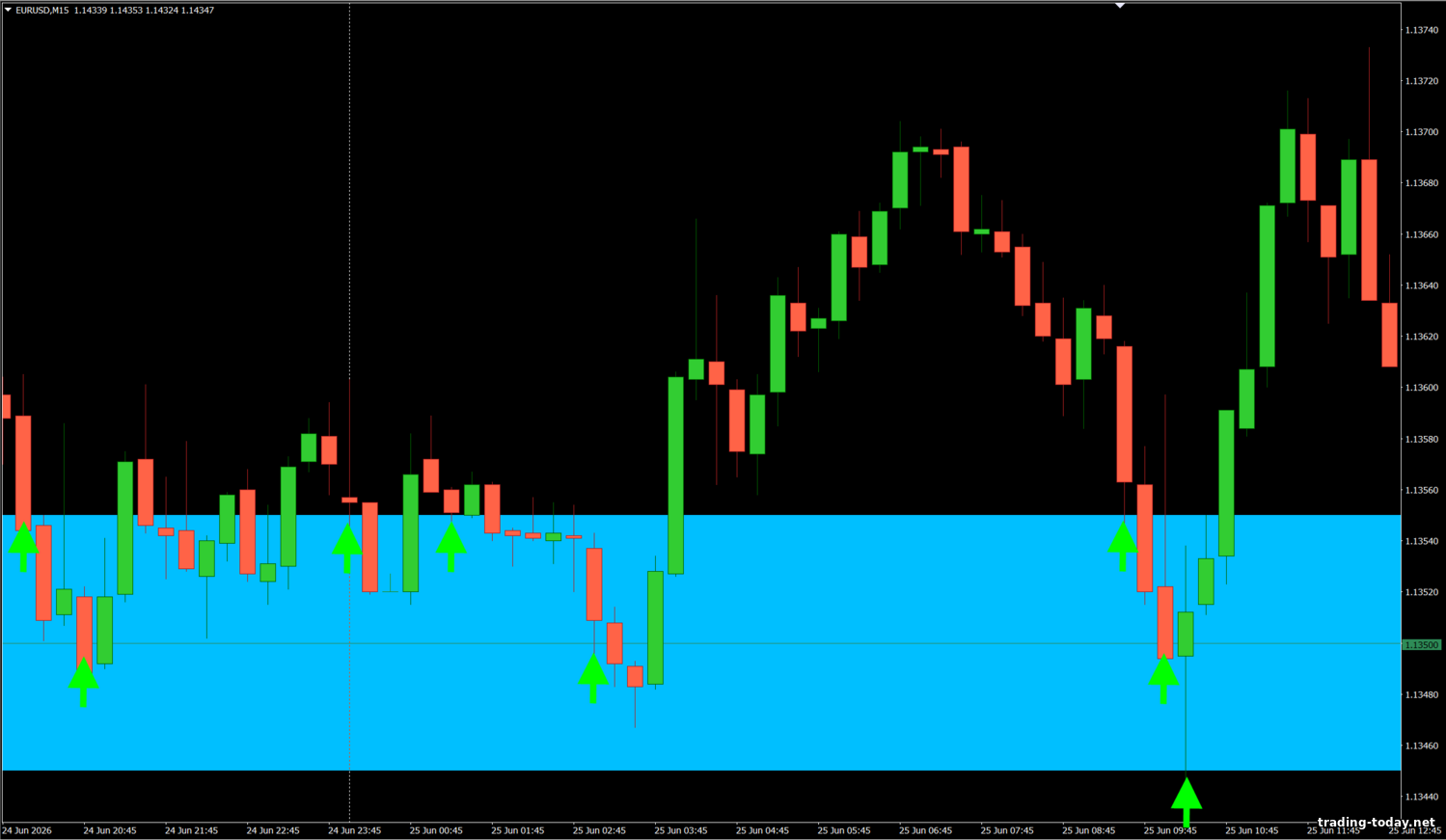
Example: if the working zone is built around the 1.2200 level and has a range of 1.2195–1.2205, then when price moves from top to bottom, the entries will be distributed as follows:
- 1.2205 — first up trade;
- 1.2200 — second up trade;
- 1.2195 — third up trade.
Important! Use only the first touch of the level — a maximum of 3 trades per zone! After all three signals have played out, wait for a candle to form outside the zone; after that, the zone can be used again.
Strong Level Strategy: Bearish Signal (Opening a Down Trade)
A bearish signal is considered when price approaches the working zone from below. In this case, the zone is treated as potential resistance.
Entry rules:
- If price reaches the lower boundary of the zone, a down trade is opened with 20% of the calculated series volume.
- If price reaches the central level, a second down trade is opened with 30%.
- If price reaches the upper boundary of the zone, a third down trade is opened with 50%.
The expiration for each trade is also set to the end of the next candle.
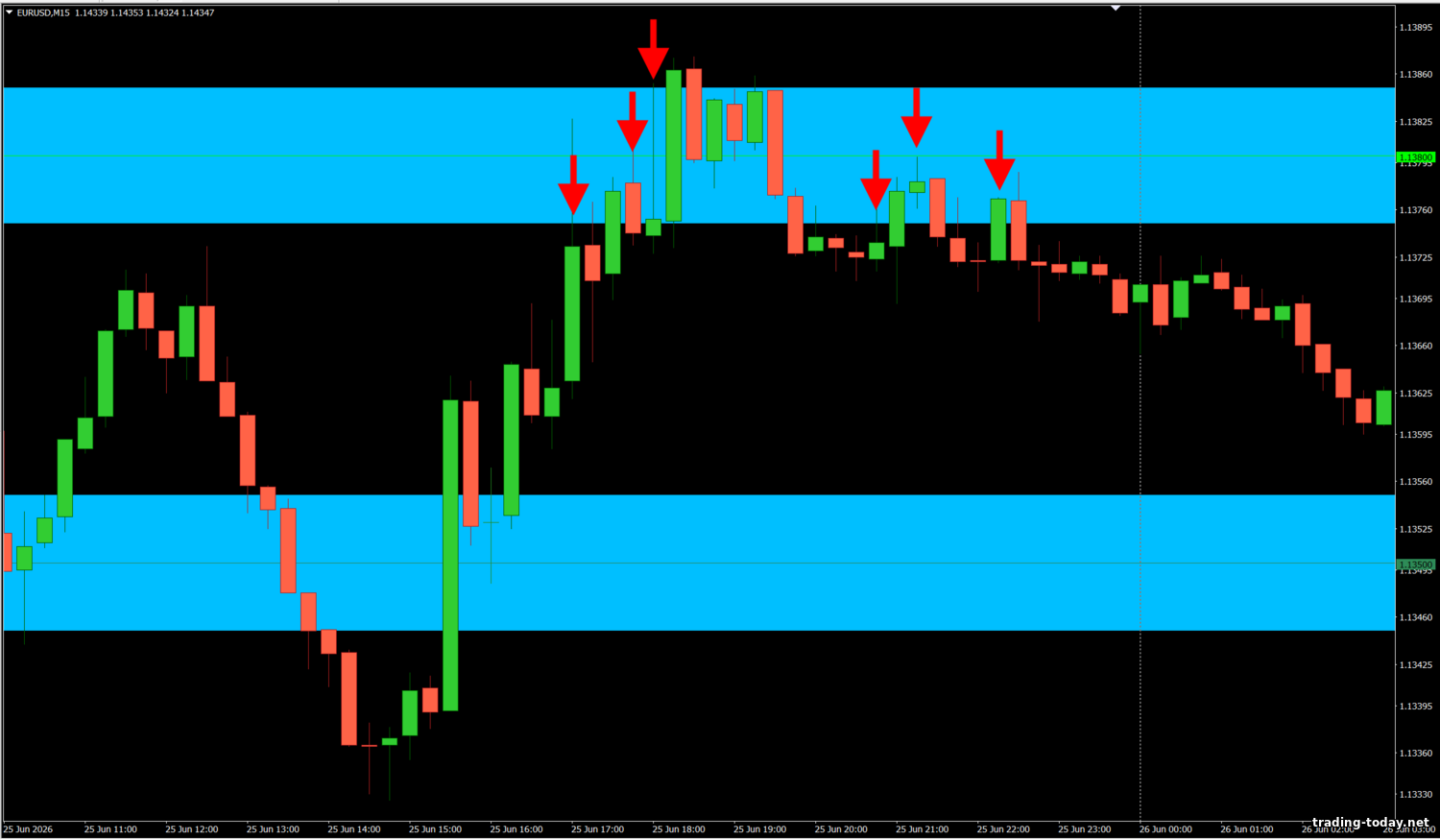
Example: if the working zone is located within the 1.2195–1.2205 range, then when price moves from bottom to top, the entries will be as follows:
- 1.2195 — first down trade;
- 1.2200 — second down trade;
- 1.2205 — third down trade.
Important! Use only the first touch of the level — a maximum of 3 trades per zone! After all three signals have played out, wait for a candle to form outside the zone; after that, the zone can be used again.
Trading on Forex and CFD
- Before trading with real funds, it is recommended to test the strategy on a demo account first by opening at least 3–5 trades
- A trade is opened only after a signal from the trading strategy appears
- The Take Profit to Stop Loss ratio should be 3:1, meaning three units of potential profit for every one unit of possible loss
- The trading time frame is not critical: minute charts can be used for scalping, while hourly or daily charts are more suitable for longer-term trading
- Take Profit and Stop Loss levels are set according to the selected time frame
- On minute charts, the strategy may generate false signals during major economic news releases, so it is better to trade on higher time frames or choose another trading period



Reviews and comments